OB820 Control Games: Secondary Obedience for Protection Sports
While the most fun part of protection sports is the biting part, there is a lot of control work that needs to be done to do the protection exercises effectively. Secondary obedience (obedience in the presence of a decoy or helper) is the heart and soul of these exercises, a dog that is not able to show control will not only lose points but could be disqualified or even be a danger to the decoy or themselves. A dog that shows control and precision even in the presence of the decoy is a powerful sight, it's what we all strive for in protection sports.
This class will teach several control games that can be done at home without a decoy or helper. Then the same games can be used in the presence of a decoy to help transfer the idea of control and maintaining clear behaviors despite that major distraction. Focus will be given on maintaining drive for bitework as well as increasing the desire to work with the handler.
This class is suitable for protection sport dogs of any age, these are foundation style games that do not require advanced known behaviors.
Course Details
Teaching Approach
Lectures will be released at the beginning of the week and will be comprised of both written lecture as well as short video demonstrations. Each lecture will include homework to work on for the week.
This class will have a Teacher's Assistant (TA) available in the Facebook study group to help the Bronze and Silver students! Directions for joining that Facebook group will be in the classroom after you register.
Syllabus
Week One
- Train Everywhere Lecture
- Food Bowl Game
- Get It Game
- Choose to heel
Week Two
- Reinforcement value lecture
- Collar Grab Game
- Get it Game: Adding the Decoy
- Food bowl: Adding Toys
Week Three
- Arousal Mobility lecture
- Marker Cue Game
- Food bowl: Adding Behaviors
- Get it Game: Teaching the Out
Week Four
- Creating Focused Loops lecture
- Recall Games
- Food Bowl Game: Do this to Get That
- Focus Forward Game
Week Five
- Start Line Game
- Follow the Toy Game
- Recall Games: Adding the Decoy
Week Six
- Search Game
- Send to Play
Prerequisites & Supplies
Sample Lecture
The Call-Off
One way to add value to your recall is to teach your dog that the recall is the most important cue and they should respond to it even if they are sent to a reinforcer such as a bite. Teaching this advanced step will help ensure that all of your recalls are as strong as they can be.
The steps to teaching your dog that the recall is more important than the task they were sent to do begins with teaching them to call-off a controlled behavior such as sending to a place. Then we can increase the difficulty by choosing a higher arousal behavior such as wrapping around an object and reinforcing with a toy. Finally, we can swap out the behaviors for sending to a reinforcer like a food bowl and recalling our dog before they get to the bowl.
For part one of this behavior, we are using our dog’s informal recall cue as well as not requiring a final recall position. Instead, we are focusing on teaching the concept that they should respond immediately to our recall and they do not need to stay committed to the task they were sent to do. In part two, we will introduce the formal recall cue, increase the level of reinforcer we send to as well as the add in the final recall position.
Begin by sending your dog to the platform. Reward your dog for going to the platform as well as when you call them to reset them. Once your dog is committed and happily going to the platform when cued, remind them about their informal recall cue for a couple of reps (give the cue, reinforce with food). Then when you send to the platform, immediately call your dog back. Mark and reward with a jackpot when they respond.
The number of reps that you send your dog to do the behavior versus the number you call off will vary for each dog. It’s extremely important that you do not decrease the commitment to the behavior or add in any hints or subtle cues that you will be recalling as both of those can decrease the value of the recall cue itself.
Once your dog is responding instantly to their recall cue, change the behavior to something more exciting such as wrapping around an object. I also like to swap out my food reinforcers for toys at this point to increase arousal. Repeat the same steps as before.
The final stage of this aspect of training the call-off is to teach our dogs to recall away from a reinforcer. It is important to know your dog’s hierarchy of reinforcers for this step. For dogs that prefer toys over food, calling off of a food bowl and reinforcing with a toy would be the ideal setup for this part. For a dog that prefers food over toys, recalling away from a toy and reinforcing with food would be better. Regardless, it’s good practice to send your dog to the reinforcer they called off of after they recall, that way they get their cake and eat it too.
Instructor
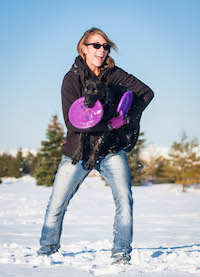
Sara Brueske
Faculty
Sara Brueske (she/her) has been training dogs for over 15 years, and has experienced a large variety of breeds and sports during that time. Having graduated as a Karen Pryor Academy Certified Training Partner ...