OB800 Mondioring OB: All-Breed Obedience
Mondioring Obedience is a fun new obedience venue catered to all breeds! Based on real-life challenges and working under distraction, Mondioring takes familiar obedience exercises to a new level. With the development of the United States Mondioring Association's Obedience-only program, now any dog can participate and earn titles.
This class will cover each of the exercises in the obedience-only program. Working spots will progress at their own pace, students can work on training the behavior or if the behavior is already known, distractions will be introduced under the guidance of the instructor.
Even if competition isn't your goal, this class will help your dog generalize their obedience behaviors to the extreme!
The exercises in the Mondioring Obedience program include:
Heeling
Down stay with distraction
Position changes
Food refusal
Retrieve
Send away
Course Details
Teaching Approach
This class is taught via written lectures with short demonstration videos. Each week will include a lecture explaining the rules of the exercise we are focusing on and include multiple example videos of the exercise in trial. A second lecture will be posted covering multiple ways to teach the exercise so that the handler may select the method they think will work best for their dog.
Syllabus
Week one
- What is mondioring?
- Typical trial
- Rules for OB/OBJ program
- Extra stuff
- A-B behavior
- Environmental distractions
- Bowl game
- Pattern games
- Start patterns
- Recall
- Heeling
- Exercise description
- Possible distractions
- Choose to heel
- Exercise description
Week two
- Retrieve
- Exercise description
- Bring to hand method
Week three
- Positions
- Exercise description
- Possible distractions
- Using a barrier
- Front foot targeted
- Exercise description
Week four
- Down stay exercises
- Check in
- Check in procedure
- Food refusal
- Exercise description
- IYC
- Anticipation of release
- Absence
- Mat stay
- Adding distractions
- Check in
Week five
- Little wood
- Exercise description
- Scent discrimination concept
- Popsicle sticks
Week six
- Send away
- Exercise description
- Send to mat
- Anticipation of reward placement
Prerequisites & Supplies
Sample Lecture
A to B Behavior
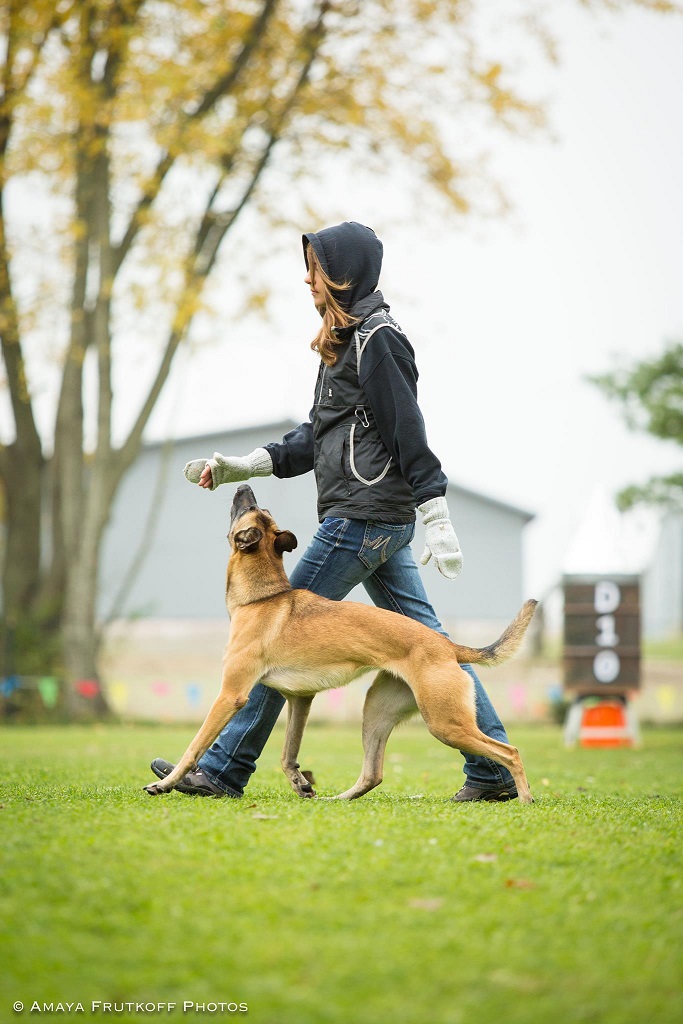
One of the most difficult parts of a mondioring trial is the time between the exercises. While some of the exercises may start close to one another, oftentimes, you are required to walk quite a distance to get to the next preparation line. For this reason it’s best to plan out what behavior you’d like to use for this particular use ahead of time.
The behavior you choose will depend on your dog. The options include: focused or heads up heel, contact heel or a loose heel without specific criteria.
As with all of the behaviors in this class, I will provide a list of pros and cons for each method as well as some options for training each behavior. Try to think about your strengths as a trainer as well as your dog’s strengths and weaknesses when deciding which option is best for you. Mondioring is a hard sport and the trials are designed to be tricky, so your A to B behavior shouldn’t be more difficult than it needs to be.
Focused heel
This is a heads up heel in which the dog maintains focus on the handler throughout the duration of heeling. This option may benefit dogs that tend to struggle with impulse control around people or objects on the ground. It also may help mask environmental worries with a high drive dog.
Pros:
- Prevents urge to eat food on the ground for food refusal (level 2 and 3)
- Prevents urge to pick up objects
- Prevents urge to go say hi to people
- Gives dog a very predictable thing to do in an unpredictable environment
- Can help higher drive dogs stay connected throughout the routine
Cons:
- Requires a lot of energy
- Because of long duration, may impact heeling picture overall
- Usually best with high drive dogs that enjoy heeling for long durations
- Needs a lot of reps and work to get solid enough for trial environment
The best exercise to work on a focused heel as an A-B behavior specifically is one that I recommend regardless of the A-B behavior you want to use. I love to use the well-known Choose to Heel as a foundation for my focused heel especially since it helps my dog learn to stay with me despite distractions. That exercise can be found in the “Heeling” lecture.
Contact heel
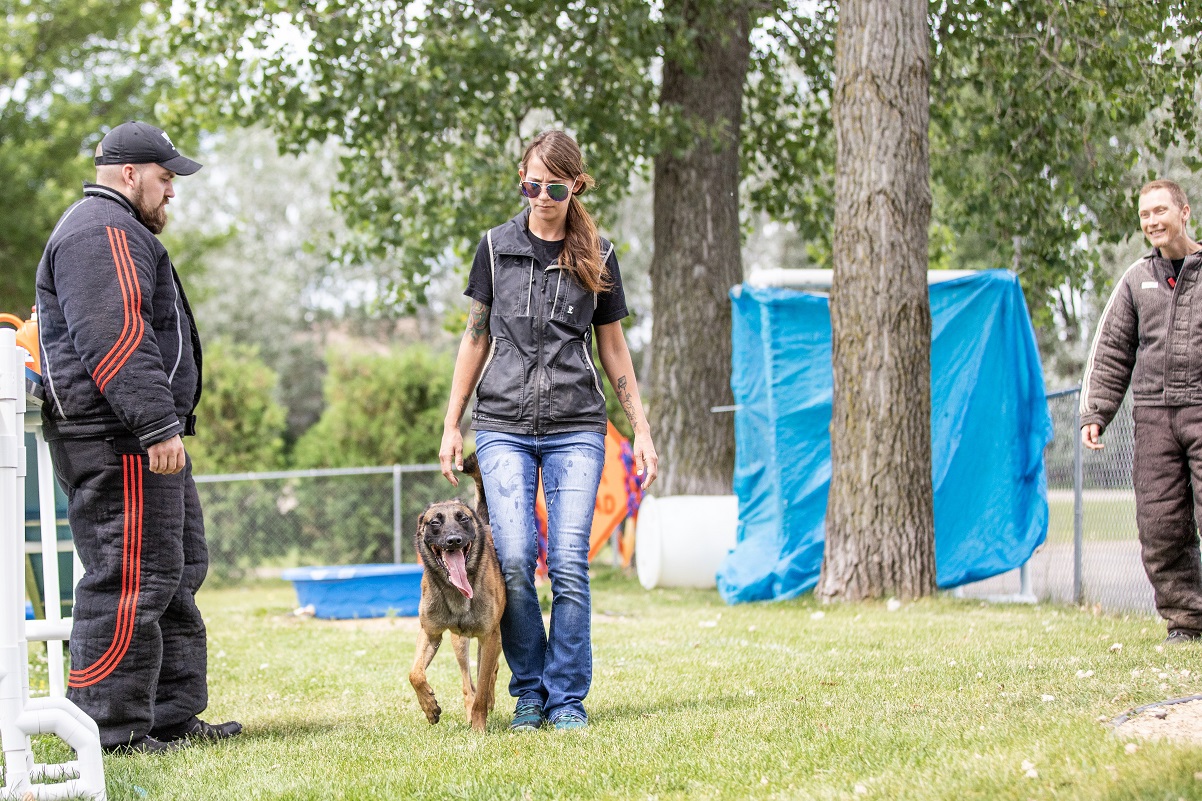
The contact heel is when your dog stays in heel position by maintaining contact with you via their shoulder or their side. This allows them to look around their environment at will.
Pros:
- Allows your dog to scan environment
- Lower energy behavior, dog is able to “relax” a bit between exercises
- Won’t risk ruining focused heel by over-using it
- Works well with lower drive dogs
Cons:
- Dogs that might lack impulse control may struggle more
- Some overzealous dogs can push into you and make it difficult to walk
- Need to teach clarification between focused heel and contact heel
This is the A-B behavior I use with Kreacher. Even though he is high drive and would be able to maintain a focused heel throughout the routine, he tends to run hot and tends to be very high arousal. The contact heel has been taught as a low arousal behavior for him, it predicts calm behaviors and calm rewards and that allows me to use it in a trial as a way to lower his arousal between exercises. It also allows him to scan the environment (he likes to look for decoys) without breaking the criteria of the behavior as it would if I required a focused heel.
One aspect that will make it easier for your dog to discriminate between a focused heel and a contact heel is to teach them on separate sides. Some people prefer to have a contact heel on their right side and a focused heel on their left side. The side that your dog heels on is not defined in mondioring, so you are able to have flexibility with that behavior.
To teach a contact heel, there are two options: pivot bowl or luring.
With the pivot bowl, your dog will need to know to pivot into heel position (on the side you intend to teach your contact heel). The steps for that can be found in the “Heeling” lecture. However, we are going to change the criteria a bit. Instead of pivoting into heel position, we are going to wait for a bit of an over rotation in the pivot. Standing very close to the bowl, this should cause your dogs shoulder to touch your leg. Mark and reward that contact. Reward multiple times if they maintain that position. Gradually slow down the rate of reinforcement so that your dog is holding that position for longer durations of time and then add in movement as you would with the normal pivot exercise, always marking and rewarding that shoulder contact.
To lure this behavior, stand with your dog at your side. Using pocket hand, rotate your dogs head away from you so that they curve their body, touching you with their shoulder. Mark and reward that contact. As your dog gets used to this movement, begin to slow down your lure and mark if your dog moves into you without it. Continue to fade the lure in this method. Bring back the lure as needed when you add movement.
With me
This A-B behavior has very vague criteria on purpose, it’s a general “stay near me” type of heeling without requiring contact or a heads up.
Pros:
- Great for dogs that struggle with working in new environments as it reduces the expectations
- Conserves energy
- No overzealous leaning for high drive dogs
Cons:
- Dog may end up moving away from you
- Distractions may be more tempting
- Can be difficult to maintain
This is the A-B behavior that I use with my malinois, Famous. Fame has a hard time working around people she doesn’t know, she tends to disconnect and struggles to maintain duration behaviors. I needed a behavior that allowed her to investigate her surroundings and keep an eye on the people that didn’t have a difficult to maintain criteria over a long duration of time. For her, that is the “with me” style heeling.
I teach this the same as I do the focused heeling, however, I reduce rewards a lot faster. Since I don’t need my dog to maintain a heads up criteria, I’m able to fade out those rewards and add more duration. The important part is that your dog still needs to pay attention to where you are moving. To achieve that, add in turns and reward quickly after those turns. If your dog is forging, simply turn the other direction, they will learn that you are unpredictable and you might “disappear” at any time so they better pay attention!
Instructor
Sara Brueske
Faculty
Sara Brueske (she/her) has been training dogs for over 15 years, and has experienced a large variety of breeds and sports during that time. Having graduated as a Karen Pryor Academy Certified Training Partner ...