OB200: Precision Heeling
Purchase all the video presentations in our Pet Dog Training Online Program! Click links for more information on individual presentations.
Course Details
Many dogs lack precise heeling because they have no foundation – they do not understand how to use their bodies with accuracy, and their trainers don’t know how to fix heeling mistakes when they occur. This class will give you specific tools that you can use to develop your heeling foundation, without using a leash, special collar, or any compulsive techniques. We will use placement of food reward, platforms and discs, "pocket hand," and activities that teach you and your dog exactly where heel position is located. Static position (as opposed to movement) will be the primary focus; however, advanced teams will be taken as far as they can go over the six weeks of class, which could include formal heeling patterns with a high level of accuracy.
All of the techniques and skills will be provided in the first week of class, so you can select the level of challenge that your dog is ready for while skipping over skills that your team already possesses. In other words, you won't be "held back" if you have some skills. Conversely, absolute beginners are welcome since we'll start at the absolute beginning!
This class will cover the details of precision rather than the “game” aspect of heeling. Because of this focus, the class can be taken even if you have no access to training grounds outside of your own home.
Please read the prerequisite and equipment tab before registering! and to get a sense of the class, a sample lecture is available - see the Sample Lecture tab above!
Is this course right for you? This class offers extensive lectures, problem solving and a specific set of exercises and criteria, to inform the handler when they will want to consider the next step. Each step is heavily illustrated with videos - the videos do not require the ability to hear them in order to illustrate the lectures effectively. This class will work best for students who prefer a structured route with discrete steps to follow. The heeling method presented her is largely a lure based method. The physical capacity to hold a small treat in one's thumb/forefinger combination is critical to encouraging the dog to take the correct position. This method also requires that the handler can comfortably hold their hand above their dog's head when the dog is stretching "up" into heel position - handlers of smaller dogs will need to be able to bend to their dog's nose level (when the head is elevated).
Check out this short informational trailer:
Syllabus
Skill 1: Place front feet on a disc
Skill 2: Maintain a "front feet up" position on disc
Skill 3: Accept body pressure while on disc
Skill 4: Four feet on a platform
Skill 5: Tuck sit; platform or disc
Skill 6: Without dog, properly create a "pocket hand" in heel position
Skill 7: With dog, properly create a "pocket hand"
Skill 8: Pivot in heel position using pocket hand and disc
Skill 9: Remove food from pocket hand
Skill 10: Pivot on disc without hand help
Skill 11: Pivot off of disc with hand help
Skill 12: Pivot off of disc without hand help
Skill 13: Find heel position on a platform
Skill 14: Find heel position on a disc
Skill 15: Left finish
Skill 16: Begin forward movement with aids
Skill 17: Forward movement without aids; no halt
Skill 18: Heeling on a right circle
Skill 19: Rght turn – with or without help
Skill 20: Left turn – with or without help.
Skill 21: Stair step heeling – without help
Skill 22: About turn/left turn/right turn/backwards/pull right
Skill 23: Speed changes
Skill 24: Call to heel "In motion" – (beginning of heeling games)
Skill 25: Squish to heel (beginning heeling game)
Skill 26: You pick!
Week 1: Lecture: Why we want precision heeling
Week 2: Lecture: Reward for Position and "pocket" hand
Week 3 Lecture: When to use a platform, a disc, or simply fingers
Week 4 Lecture: Muscle Memory vs Conscious thought
Week 5 Lecture: Adding Movement
Week 6 Lecture: When does this get FUN??!!!
Prerequisites & Supplies
1. Treats that will "magnetize" your dog (dogs must be food motivated for this course)
2. A quiet working space without distractions. (course can be worked in a very small indoor space such as a bedroom)
3. A small disc for your dog's front feet. Ideal size is the width of your dog's front stance plus a couple of inches. Height is about 1" to 4" high. Examples would be an overturned food bowl, a frisbee, or even a pan from the kitchen that lays flat! Make sure it is round. Some students buy flat foam pieces used for kid's bedrooms and cut them to the right width in a circle shape - stacking them as needed to give the desired height. In the beginning, a slightly taller platform (3 or 4" is ideal) and that will be reduced over time. If your dog is comfortable and willing to pivot on a smaller disc right from the start (1") then that's fine too.
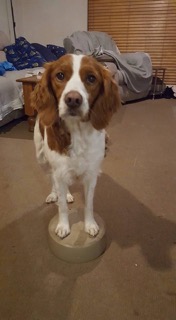
4. Small platform - ideally the final platform is the width of your dog's front stance plus about one inch. Length is the size of the dog in a sit. Height is approximately 1" high. For a "learner" platform, it is helpful to have a larger platform which the dog can easily sit or stand on and wider than the final platform. 2" or 3" high is a good size. For many dogs, a wooden plank (purchased at home depot or that type of store) is perfect - you can have them cut it down if necessary, but for this class better too large than too small.
Sample Lecture
This class is comprised of four lectures and 23 skills. In combination with the forums for problem-solving, a student will acquire the skills to train precision heeling or to re-train problems with their basic heeling foundation. The following are the first four skills from the skill set.
Skill 1: Place front feet on a disk
Method: You may either shape or lure this behavior.
Video Demo:
(lure)
Note: Teaching your dog to keep the feet up even when you move is very very important - I like to be able to move out about five feet without my dog getting off - that makes the second step (pivoting) much much easier. So...do not rush this step! In the above video, the dog was extremely cooperative - she understands training so she understood what I wanted right away. If your dog avoids the disc, try for one foot first. Even if the dog just brushes the disc with a foot, give a cookie. Position the cookie over the disc as you feed so that the dog is more likely to decide to step on it to reach the cookie than to try going around.
If your dog REALLY does not want to stand on the disc, try a full stair step first - if you have stairs in your house then this will be easy - stand at the bottom of the stairs and hold the cookie in a manner that will cause the dog to reach forward and step up to get it with their front feet. First one foot and then two feet. Then go back to your disc - some dogs just need a bit of help to get that first step up. Still struggling? Change the surface of your disc. It may be slippery or shiny or...who knows?
Skill 2: Keep feet on the disc
Method: After dog’s feet are on the disc, step slightly away and then return quickly to feet a cookie. If your dog’s feet come off, help them back onto the disc and then try again. Start slow! Just a few inches away from the disc and back. In this video, Brito is working on keeping his feet on the disc. He is relatively new to this, so you can see how I handle it when he comes off. Note that I back in and out from the disc- rewarding for staying up. Make sure that both feet are on the disc when you reward! I am also doing a very small amount of rotating (for skill 2 below):
Skill 3: Dog maintains a “front feet up” position even as you move around the disc.
Method: start very close to your dog. Move slightly left or right with your hands centered in front of your dog (with a treat if you prefer to lure; without if you are a shaper). Treat immediately for any movement. Slowly increase the number of steps dog must take before rewarding. Don’t sweat the straightness of the dog in front at this point. Continue until your dog can do 180 degrees in either direction. You should be moving relatively slowly so your dog is controlling their movement.
Video Demo: In this video, I am working with a dog that does not have this skill already, so you can see how I help her to develop what I want.
(learning with lure – tervuren raika)
Video Demo: In this video, you’ll see the finished product - Lyra already knows how to move on the disc. Note my hand position in front - if you center your hands in front, your dog will be much straighter.
(shaped - tervuren lyra)
Video Demo: This puppy is just learning! See how we handle his mistakes, but we want him to be correct as much as possible. we are using food placement to try and keep him relatively straight in front:
(Puppy Brittany Cruise – lured with hand pocket from the front)
Video Demo
Same puppy as above but his second lesson:
(puppy Brittany Cruise lesson 2)
Video Demo: This is the same video from above for skill #1: Note that Brito actually turns more easily if I am further away from him when I rotate; that’s fine too! Find what works best for your dog. Because Brito is also learning to offer positions, you’ll see him doing all sorts of things. Just ignore the positions and focus on what his front feet are (or are not) doing:
Skill 4: Accept pressure of your body near disk:
Method: Teach your dog to be comfortable with your feet very close to the disk in both front and side position. Note that my feet are centered and facing the disk, or parallel to the dog and disc when I am standing next to my dog (heel position). If your dog avoids you and tries to leave the disk as you move in closer, take your time. This is normal. If your dog tries to come to front position when you attempt to move to the side, use a piece of food on the outside of his head to hold him still (shown in Lyra video)
Video Demo:
As you can see, this skill is new to Raika. Note that the pressure of my body plus the movement of the food is not enough to get her moving, so I put my knee out to add pressure. She understands and the second time she moves on her own
(front position – trainee Tervuren Raika)
Video Demo: In this video, you should be focusing on how close I am to the dog; the fact that I added a pivot was simply to give you a better camera angle - do not add this step at this point unless your dog already understands pivoting on a disc:
(Tervuren Lyra moving to side with tiny pivot on side)
Instructor
Denise Fenzi
Faculty
Denise Fenzi (she/her) has competed in a wide range of dog sports – titling dogs in obedience (AKC and UKC), tracking (AKC and schutzhund), schutzhund (USA), mondioring (MRSA), herding (AKC), conformation (AKC), and agility (AKC). She is best known for her flashy and precise ...