OB300: Heeling Games
Purchase all the video presentations in our Pet Dog Training Online Program! Click links for more information on individual presentations.
Course Details
Lack of motivation in heeling is one of the prime reasons that people give up on the sports of obedience and rally. Rather than seeing heeling as a dynamic, intense interaction between partners, heeling is often seen as a drudgery that must be endured as part of general training.
Nothing could be further from the truth! Done well, heeling is an intense, exciting dance between engaged partners requiring absolute concentration and energy. When heeling is practiced as a series of specific behaviors – left turns, right turns, change of pace, etc. - the dance is lost. This class will teach you how to practice heeling as a game – with the end result that your performance will be sharper, more interesting, and with much improved focus and endurance.
This course will help participants learn to create excitement and interest in heel work with their dogs, rather than focusing on the actual skill of heeling. By increasing their attractiveness as a heeling partner, external reward schedules can be decreased at the same time that natural attention is being developed.
Denise will introduce one concept at a time, and then will provide games to help you apply that concept. This class will cover the concepts of opposition reflex, increasing dog involvement through movement, appropriate reward placement, developing rhythm, making the expected unexpected, and more!
Is this class right for you? To utilize this class, a dog needs a few steps of good quality heeling but not much more than that! Lectures are relatively short and are designed to explain the games. There are no verbal lectures. Videos are generally short and targeted to helping the student learn and apply the games to their situation. Many of the games require the ability to move quickly, bend, or "sprint" away from the dog, but others require no movement from the handler at all.
Syllabus
Lecture #1: Adding Horizontal Movement
fly and thru/leg weaving
Lecture #2: Adding Vertical Movement
hand touches with escape, jumps and tunnels
Lecture #3: Patterns vs. Unpredictable
understanding the tradeoffs and selecting appropriately
Lecture #4: Opposition Reflex
how to use it, when to use it, combining with pocket hand, warning signs!
Lecture #5: Sit at heel/Exploding Tree
creating speed and explosive releases at heel; regaining precision with control
Lecture #6: Heeling with a Toy
how to do it, when to do it, and why to do it!
Lecture #7: Right Circles to Improve Momentum
balancing drive with control, circles within circles
Lecture #8: Get Rythym!
duplicate the ring experience, identify weak points in heeling
Lecture #9: Get Rythym in Sync!
Metronome heeling with a dog
Lecture #10: Making the Unexpected Expected
Using incompatable behaviors to improve heeling, considering the temperament of the dog when selecting behavior pairs
Lecture #11: Creating your Future
balancing drives, games and precision - what makes sense for your team?
Lecture #12: Reducing Reinforcers
The role of games in reducing reinforcers
Prerequisites & Supplies
Note: Precision heeling concepts (OB200) will be referenced and will not be reviewed here. If you have heeling then this course will benefit you, even if you did not take Denise's Precision Heeling course to get it! Precision Heeling is offered as an active class for the June 2017 session and will be available for self-study purchase after that session is completed.
Equipment needed: toys or treats, a cone or other vertical object for your dog to circle. Near the end of class we'll need a metronome (available for free as a smartphone app).
Space required: “Ideal” space is open with good footing. This class is not suitable for an indoor "home" space
Sample Lecture
Lecture #1: Horizontal movement to build drive in heeling:
By definition, heeling is a highly precise activity. In their efforts to be precisely where you want them to be, your dog must give a good deal of focus, energy and body awareness at all times. To free a dog up, we need to give them permission to leave heel position as often as necessary so that they may stretch their bodies and their minds. After these mini “movement” breaks, preferably with the dog at a run, we also need our dogs to come back under precise control almost immediately. This tension on/tension off creates a balance that gives you beautiful, relaxed heeling without losing precision.
Allowing your dog to leave heeling – and return with energy – will be fundamental to your success in this class. ALMOST EVERY EXERCISE WE DO IN THE CLASS WILL INVOLVE THIS TENSION ON/TENSION OFF METHOD. The following exercises which are introduced here are the core of the heeling games. Teaching your dog to have fun with movement is everything! Heeling is simply one more form of movement – albeit with a lot of rulesJ.
To create movement, we start by giving our dog permission to leave heel position on cue. To do this, use a tunnel, an object to circle, jumps, hand touches (vertical movement) or even your own legs! I call this approach to training obedience “games” because it blends the requirements of precision with the movement and freedom of play.
To help you grasp this idea, here is one of Lyra’s earliest lessons in Obedience games. Note that I use movement – jumping, running around an object, and high hand touches, to try and build her interest in heeling:
To teach obedience games:
At a minimum, your dog needs to be able to move away from you on cue. For most dogs and handlers, circling an object such as a cone or a folded stanchion works very well – both are highly transportable and easily acquired.
FLY
To help you teach this skill, here is a video of Cisu’s First lesson in “Fly” (Fly simply means to circle an object and return)
By using “fly” liberally in the middle of heeling, your dog may run away (moving their bodies) and then pull back into precise heeling when they return. This creates the basis of the “tension on/tension off” between drive and control which was referenced earlier.
In this video, you can see two different ways that I get Cisu away from me so she can drive back into heel position. One is ”fly” and the other is a food toss. In both examples, she then catches back up to me and resumes heeling:
In this video, I’ve taken “fly” one step further. In addition to sending her out and away, I asked for a ‘down’ next to the object before allowing her to return to me. This is appropriate for very high drive dogs that need as much control in their work as possible. Do not overuse this or you will lose your dog’s drive and energy, thereby negating the value of the game! In this case, very occasionally adding a down or stop command, I guarantee that Cisu pays attention even at a distance; she cannot assume that she is always “flying” back to me:
In this video, I’m using “fly” only to increase energy into heel position. Note that even though Cisu comes back into heel position, I quickly turn on a right circle to continue the forward momentum. Maximum fun for the dog! Also, note that I throw the toy straight ahead so she not only flies back and circles, she flies right by! If your dog struggles with control this is not the best possible exercise for you – focus on getting the dog to drive up into heel position first and show some understanding of holding in position for a few seconds – and then reward in heel position rather than straight ahead. Remember, all training should be geared to your dog’s unique needs:
There is no reason to start heeling with formal set-ups, or with the dog at a sit in heel position. Try using “fly” instead of a setup, and see where it takes you! Just enter your training area, send your dog off and around, and when your dog returns you can begin your formal work.
THRU/leg weaving:
In addition to “fly” you can add a second obstacle to create continuous motion – one of the easiest is to use is your own legs! I call this “thru”
Here is an early lesson for Cisu in “thru”. I start by luring with a toy, but quickly move to my hand as a target, with the toy as a reward. You could certainly perform the same movements with a cookie (indeed it would be easier). Just remember to get off the cookie lure as soon as possible, and use your hand as a target instead. Cisu’s lesson uses a toy lure followed by a hard target:
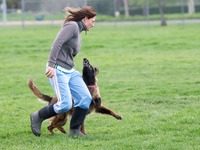
Here is a BIG dog and a LITTLE person learning “thru”:
I’m teaching Lyra to continue on “thru” to both sides, which creates “leg weaving”. Whenever you want, you can go back and forth between leg weaving and thru. you can also alternate leg weaving to a reward with leg weaving right back into heeling. Here’s Lyra learning leg weaving:
If your dog wants to come around your legs rather than going through, watch this video. This problem is so common I’d say 80% of handlers will run into it, so remember: It’s important that your hand go behind your back and then down rather than wrapping around your leg where your dog will see it and want to follow!:
Conclusion: The purpose of this lecture is to show you ways to create movement and energy in your heeling. Note that I never ‘set up’ to begin heeling – I simply allow it to happen. ‘setting up’ is an important skill that your dog must learn to master precision in heeling, but the majority of the time it’s perfectly ok to start heeling without a formal start – or a formal stop!
Homework: Teach your dog “fly” and “thru”. You won’t’ master it this week but let’s get started and see what we can do with it. Send me a video of your progress (or your pleas for help)J. If your dog “gets it” and you want to add some heeling upon the return, go right ahead. If you struggle to regain control, offer the “pocket hand” from the precision heeling class just long enough to bring your dog into control; then back to regular heeling until you decide to throw in another game.
Instructor
Denise Fenzi
Faculty
Denise Fenzi (she/her) has competed in a wide range of dog sports – titling dogs in obedience (AKC and UKC), tracking (AKC and schutzhund), schutzhund (USA), mondioring (MRSA), herding (AKC), conformation (AKC), and agility (AKC). She is best known for her flashy and precise ...