FE101: Relationship Building Through Play
Purchase all the video presentations in our Pet Dog Training Online Program! Click links for more information on individual presentations.
Course Details
We'll discuss the correct presentation of toys, learning how to make cookies into an event, and understanding how to interact with your dog in the way that he likes best. It takes time and effort to learn your dog, to know what to do, when to do it, and when to STOP doing it. Taking this time is well worth the effort because the end result will be a dog who naturally looks to you for both direction and entertainment.
This class will introduce one form of play at a time. With over 70 videos featuring a variety of breeds, sizes of dogs, and handlers, you're sure to find the information you need to form a fun and satisfying play relationship with your individual dog!
Is this course right for you? This class offers extensive written lectures, no verbal lectures, and many videos of varying lengths (up to 5 minutes), designed to help a student understand the context of a play session - what works, what does not work, and how that will vary by dog. It is rare that relevant speaking takes place within a video; they are designed to be watched and follow with the ideas presented in the lecture. There are no specific homework assignments as this is a concept course that requires studying your dog and finding the route that works best for your team. A wide variety of techniques will be suggested and illustrated with video. This class will work best for students who learn best by reading text lectures, watching videos and who feel comfortable trying out a variety of approaches until they find the ones that works best for their dog.
Syllabus
.
Lecture #1: Three primary types of play (Toy, Personal, and Food Play)
TOY PLAY:
What it is and why we do it
PERSONAL PLAY
What is it?
Why we do it
Play vs. Praise/approval
FOOD PLAY
What is it?
Why we use food play
Best uses of food play
Control and drive building; which ones should you focus on?
Lecture #2: Baseline video
First Video Assignment
Lecture #3: Toy play
What would the squirrel do?
Your dog is avoiding toys
Let dog get the toy
Tightening up the game – removing the lunge line
Dog working harder; Handler working less
Ending the game
Handler Comfort and Safety
The Release on a Trained Dog
Rebites
Increase a dog's interest in balls
Lecture 3.75: Reducing Possession with Tiny Tugs
tiny tugs
Tug Toy Selection
Why Toy Selection Matters
Toys for Building Drive
Examples of toys used to incite prey drive are:
If your dog has low confidence or is easily intimidated
Toys for Training
Training Toys for Hard Biters
Training Toys for Soft Biters
Conclusion
Lecture #4: Personal Play
Getting started – Expression
Auditory cues
Body Posture
Movement
Physical Touch
Play as movement
Quick changes of direction
Vertical movement
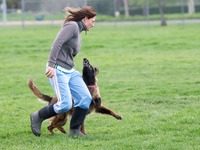
Jumping on the trainer
How do dogs play?
Lecture #5 - Video samples of play
Lecture #6: My dog is biting me!!!
If your dog is mouthy or tends to over arousal
Biting during toy play
The important point here...
Lecture #7: Frontal Pressure, Breaks, and Matching Energy
Frontal Pressure
Taking Breaks
Matching your dog's energy
Homework video
Lecture #8: Tension vs. Movement
Many sample videos
Lecture #9: Food Play
Prey Games
Food as Prey
Food as Prey with Opposition Reflex
Control Option
Trainer as prey
Control Option
Jump for Food
Control Variation
Chasing hand with food
Opposition reflex games with food
Opposition reflex from between the legs
Control version
Hunt for Food
Control option
Mousey Mousey Game:
A little of everything!
Video Homework
Lecture #10: Pressure
Direction of travel
Direction you are facing
Your expression –
Your voice –
Silence
Eye contact
Imitating a dog’s natural play
Snapping AWAY
Dragging a dog behind you with a toy reduces pressure.
Lecture #11: Play with Children
Lecture #12: Combined Play
Lecture #13: What does your DOG love? Understanding Life Rewards
Lecture #14: Aggression vs. Play
Lecture 15: Incorporating Play with Work
Prerequisites & Supplies
Prerequisites: Open to all
Equipment needed: A range of toys for tug/ball play and treats for food play. video camera/access to YouTube upload required for Gold level participants
Space required: “Ideal” space is open with good footing. “Minimum” space is any bedroom or living room sized area with good footing.
Sample Lecture
Lecture #3: Toy play
Toy play is one of the hardest and most complicated things to talk about because very small changes in our technique can make big differences in the dog's response. One of the easiest ways to think about playing with your dog is to consider the natural prey sequence. Dogs are attracted to the movement of a prey animal AWAY from their direction of travel. When the animal is caught, it must try to escape! To be interesting, the dog needs to have a fight (catching a lizard is not nearly as interesting as catching a squirrel because of the contest).
What would the squirrel do?
The most important factor in developing your dog's toy interest is the action and movement of the toy. With this in mind, always ask yourself, "What would the squirrel do?"
Visualize a fence with a squirrel on it. The first time your dog notices the squirrel is probably the first time the squirrel notices the dog. The dog will look intently and possibly move towards the squirrel. The squirrel runs away! Note that the dog did not catch the squirrel - it's likely he never came within 50 feet of the squirrel - but the next time your dog sees the squirrel, there will be an additional edge of curiosity and boldness. The dog is likely to start moving towards the squirrel much more quickly, and possibly with focused intent. Again, the squirrel runs away!
Although the dog never gets near the squirrel, this lack of interaction does not diminish his interest in getting closer. Indeed, the escape of the squirrel will increase his interest and further pique his prey drive. A large part of the excitement of the hunt is visually tracking the movement of the prey; visual tracking is rewarding in and of itself. Each time your dog has a visual interaction with that squirrel, he gathers information. He learns how fast squirrels can run, what direction of travel they prefer, and what causes them to panic. These experiences will build his confidence, his visual tracking will improve, and his determination to catch the squirrel – or at least to get much closer to it – will also increase.
In short, the dog does not need to get to the prey in order to show increased interest, focus, drive, and energy. This reality is very important, because the biggest mistake trainers make in playing with tug toys is that in the desire to get the dog to hold the toy, they forget the all-important process of engaging the dog's interest using prey moves with the toy.
Squirrels are NOT suicidal. Squirrels do not move towards a dog, except in a panic. Squirrels don't subject themselves to a thorough sniffing. Squirrels are highly frightened of dogs in their first few encounters and their behavior reflects this. They run away and try to escape. Over time, an experienced squirrel might become bolder around dogs – waiting longer to run away – but this comes well after the dogs are bound and determined to get to them. What is the dog's reaction to this escaping prey object? They will display increased intensity, focus, and desire to move from a quick look in the distance to bridging that gap between them as quickly as possible. This is the beginning of the chase. If you do not respect this natural chain in behavior, then you are undermining your dog's natural prey based behavior, and next thing you know....
Your dog is avoiding toys
The sight of a toy causes the dog to walk away or get scared. This is bad news. If you've gotten yourself into that mess, the answer is not crating your dog to create desire. You need to start over again with the best possible technique you can master.
If your dog is a complete beginner or undergoing retraining
Attach your drive-building toy to a lunge whip (available online or from a feed store). A long stick or dowel with some rope will do in a pinch. Begin to move the lunge whip/toy combination in an erratic, squirrel-like fashion: always away from your dog. It's a good idea to work without your dog (videotaping yourself) until you can consistently control the lunge whip. Ninety percent of your time should involve keeping the toy on the ground with the occasional jump in the air. Remember, most squirrels do not fly, and catching a fast moving, vertical toy out of the air is certainly not a beginner skill.
here is a fantastic video of the toy in the hands of a trainer behaving like a squirrel - peaking out and hiding, until finally, the dog gets a hold of it:
Practice moving the toy at different speeds and with different changes of direction. The speed and direction of the toy will depend on your dog's reaction. If you practice without a dog and with a video camera, you will improve more quickly.
Now, if you trained without the dog, go watch the videotape. Does your toy remind you of a squirrel? If yes, good! Go get your dog. If not, study your video until you can pinpoint your errors. Too much time in the air? Too slow? Straight lines? Work on this until you are satisfied that your play style is unpredictable, fun, and interesting. Be the squirrel!
Let dog get the toy
Okay, if you've been practicing, then your dog should be looking pretty excited about catching this toy. Remember to move the toy in an erratic fashion — left, right, quick jumps up, but mostly down on the ground. Now it's time to let the dog attempt a catch. To fool the dog into thinking he really did win, you can either "accidentally" change directions across the dog's path, or flip the toy up like a leaping squirrel just as the dog is approaching with great enthusiasm. Most dogs will be able to grab some part of the toy, especially if you are using a soft, squishy toy that's long and easy to bite. We want the dog to feel victorious.
From your position at the end of the lunge line, become the squirrel. Panic! Snap your "body" to try and escape. Squeak. Maintain light, constant pressure and tension on the line with a slight give and take motion (similar to fishing!). If at any time your dog loses his grip or becomes unsure, it is critically important to take that opportunity to escape. All dogs make a mistake eventually; it might take two seconds or a couple of minutes. When the toy escapes, run for your life! Snap up the toy with the end of the whip and allow the toy to escape to a safe place – out of reach of your dog.
Make sure you talk to the dog the entire time. Talk about how much fun you had and how you can't wait to play the game again! Do not give a second chance; let your dog sleep on what happened. Do not play again in that session, but you can do this several times in a day. Squirrels rarely give predators an immediate second chance.
When your dog becomes tenacious – grabbing hold tightly and pulling backward - you've been roped into a game of tug. Go ahead and play tug, holding on to the rope or the lunge line handle.
Here you can see puppy Reacher working on a lunge line, and then transitioning to a toy in the hand:
Tightening up the game – removing the lunge line
When you tighten up the game by removing the lunge line, the location may be the same place you worked with the lunge whip, or it may be a new location. If you move indoors, work on a surface with good footing, such as carpeting. Remove the whip from your drive building toy, and keep the toy high out of the dog's reach until you are ready to begin.
Grab the toy at one end. If the toy has a handle, grasp the handle completely in your hand so none is showing. Pull the dog in close to you; if he's small, you can hold him on your lap with one hand. If he is larger, simply keep your arm around his neck and hold him back by the chest. If you're dealing with a young adult you cannot control one-handed, you can hold on to a wide, buckle collar or harness.
As soon as the dog is secured, flip the toy out as far as possible in front of you and move the toy erratically. Your goal is to imitate that teasing squirrel — the same moves as you did with the lunge whip, but now you have the toy in your hand. Move the toy quickly in a direction away from the puppy and then move it in an erratic zigzag pattern back and forth, occasionally disappearing behind your back for a second. Then quickly have it re-emerge into the dog's view. The toy should move both quickly and in a wide arc out away from your (and the dog's) body to the greatest extent possible. If the toy stops moving, it should only be for a second or two, and never close enough to the dog that he can actually reach out and sniff or touch the toy. Keep this motion up for at least 5 to 10 seconds without releasing your dog.
Your dog will likely show a physical reaction to the toy. If the reaction appears to be avoidance, either by trying to get further away or by carefully not looking at the toy, go back to the lunge whip but shorten the whip so the puppy becomes more comfortable working near your feet. Slowly shorten the lunge line until you can hold the toy in your hand and your puppy shows curiosity and an interest in pursuing the toy. Then try the above-mentioned steps again. There is no rush; some dogs need time to get used to this new game.
If your dog's reaction is to desperately try to get free of your grip to get the toy, let go! This is EXACTLY the reaction you want. Initially attempt to keep the toy out of the dog's reach to build prey drive to maximum levels before allowing him to grasp it.
This is Juno chasing a soft, fun toy:
The right amount of pressure
You should be using the amount of pressure that allows you to constantly "feel" your dog's mouth as you continuously move the toy. Most of the time, the motion of the toy should be relatively smooth and side to side in direction. Every once in a while go ahead and "panic." Allow the toy to jerk a bit. This occasional jerk will keep the dog alert and prevent lazy bites or letting the toy hang loosely in the mouth. If the dog lets go of the toy, you must make the toy instantly spring back to life like a squirrel determined to escape. Make sure the dog is fully engaged again before allowing him to have another chance.
Here is Lexi learning to hold on!
Here is a small puppy, Brito, chasing a toy and grabbing hold. Note the erratic and constant movement of the toy, even after he wins it!
In terms of movement, the easiest motion for the toy is a figure eight with your toy hand on the floor. That motion allows the toy to constantly change direction and keeps it in front of you, but also allows you to get the toy fairly far in front so the dog doesn't worry about being too close to your body. To avoid getting your hands bitten, keep the back of your wrist towards the dog and keep up the figure eight motion (like twirling a baton), with the dog on the outside of your arm. With this motion, the dog will be moved around by his whole body once he grabs the toy. The result should be less work for you and more for the dog. If you are doing this correctly, your arm will be moving in and out, first away from and then back towards your body in a figure eight pattern.
Here is puppy Kindi:
Dog working harder; Handler working less
Over time, the dog will bring more and more energy to the game, which is the time you will switch to a shorter, stiffer toy that is much easier to use in competitions. Not everyone chooses to make this switch, but it will help prevent problems with possession (dogs are more likely to possess a toy that is soft and whippy because they don't need you to in order to have fun with it; they can play alone). It also helps with dogs who bite your hands since whippy toys tend to cause re-gripping up the toy towards your fingers.
Here is Juno soon after making the switch to a harder, stiffer toy. Note that I am constantly moving back and away from her, to encourage her to drive back towards me. Juno is a fairly possessive dog by nature.
Note: this is the first half of the first toy lecture only. The bold sections which follow are not included in this free sample lecture, but are included in this class lecture.
Ending the game
sHandler Comfort and Safety
The Release on a Trained Dog
A Word about Taking the Collar to get a Release
Rebites:
More dogs playing!
Homework
Sample Homework with Lyra
Supplemental videos
Instructor
Denise Fenzi
Faculty
Denise Fenzi (she/her) has competed in a wide range of dog sports – titling dogs in obedience (AKC and UKC), tracking (AKC and schutzhund), schutzhund (USA), mondioring (MRSA), herding (AKC), conformation (AKC), and agility (AKC). She is best known for her flashy and precise ...