FE410: Stir Crazy - Games for Small Spaces & Indoors
Purchase all the video presentations in our Pet Dog Training Online Program! Click links for more information on individual presentations.
Course Details
While playing, you will both practice foundations skills and concepts you’ll need in dog sports the rest of the year: impulse control, directionals (left and right), recalls, send aways, adding distance, and generalizing the nose touch and push. Also front and rear crosses for agility and freestyle. Your dog will learn to do behaviors both when moving towards you and while moving away, and he will be introduced to some overall body awareness. Meanwhile, you will learn some shaping techniques, how to break the games into small achievable pieces, how to put them all together, and how to build complexity in the games.
This class will be especially good for building confidence in fearful and sensitive dogs, and it's ideal for dogs too young to jump, those with joint issues, and older dogs who might struggle with pain.
List of some of the Games:
- 3 Body Awareness Games
- Around We Go!
- A Cone and a Chair
- Star Crossed
- Parachute Recalls
- This Way and That
- Spiral
- Mazes
- 9 ball games including
- Ball Edge Game
- Cheater! Cheater!
- Dog Dominos
- Clown College
- Nose Strike!
- Ping Pong
Check out the trailer!
Here is FDSA student Cat Morgans' video of what she accomplished with her two Schnauzers Pixie and Lola. This was her very first Fenzi class. Didn't they all do well?
Syllabus
There are two types of games:
- moving around an object
- working at a distance from handler
- learning and using directional cues (left and right) and generalizing to different behaviors
- cue discrimination
- chaining behaviors
- shaping behaviors
- body awareness (not knock the cones over)
- learning to be sent away from handler while doing cues
- learning to move towards the handler while doing cues
- front cross (for agility and freestyle)
- rear cross (for agility and freestyle)
- generalizing cones/objects as a concept (that many different games may be played with them)
- stimulus control over behaviors cued near the cones
- distraction training (food and toys)
- learning how to control environment (making noises)
- impulse control
Prerequisites & Supplies
Prerequisites:
Eager closed-mouth nose touch on the palm of your hand -- ideally on other objects held in hand and away from handler such as a nose touch to a door.
It will speed your progress if your dog can already be sent around an object at least 3 feet away from you on verbal cue and/or hand or arm signal.
Basic recall at 20 feet (in the house or yard)
It helps if your dog can 'wait' and 'back up' but not mandatory
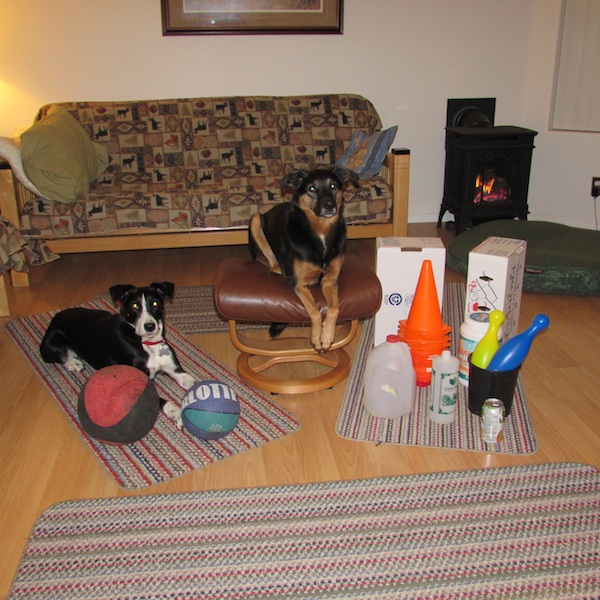
Materials:
-at least 16 (ideally up to 25) freestanding objects 8 inches or taller (traffic or kids soccer cones, boxes, chairs, plant pots, buckets, plastic milk jugs, etc.) ideally all similar size and shape, but can mix and match as needed.
-deck of playing cards
-carpeted flooring, large floor mat or rubber-backed mats for slick floors to prevent slipping during running corners
-large thick towel
-large plastic child's toy car
-two smallish boxes, pots or bowls the same size (size depends on your throwing accuracy -- the poorer your aim, the larger the container)
-cardboard box, tunnel or child's play house large enough for your dog to comfortably run through
-green painter's tape
-medium ball (6-12 inch diameter for medium dog, smaller for small dog, bigger for big dog). Check garage sales and second hand stores. A beach ball is too light (unes you have a fearful dog then we use this to start with). A small basketball is ideal for a medium-sized dog.
-at least 6 objects that are too large for your dog to chew that can be knocked over (kids plastic bowling pins, plastic piggy banks, small vertical boxes, plastic plant pots, 2 quart pop bottles, freestanding dog toys like Kongs etc)
-for fearful dogs:-a variety of different objects that can be knocked over, from light ones to noisy ones
-different floor surfaces (from carpet to wood) and a sheet of metal
-clicker (optional) -can use verbal marker too
-many soft small training treats per training sessions suitable for indoor (low level) distractions (real meat or cheese, or for highly food-motivated dogs Cheerios.)
-toys (tug, balls, soft toys to toss)
-treat pouch
Sample Lecture
Now, with the dog starting beside you and the cone about a yard (1 m) away from you, send the dog around the cone and move to your other side.
As she is successful, add more distance between the chair and the cone. Make sure there is enough room behind the cone so the dog can get between the cone and the wall or other furniture in the room.
Here when Lucy hesitates to do the distance, I recall her to try again. This appears to give her confidence as she speeds up as she runs towards the stool.
While sitting in the chair, use your hands with verbal directional cues to guide your dog in a figure 8 around the chair and the cone and mix in the leg weave and under behaviours. Train the other direction as well. Once you have added some distance and the other behaviours, you have a fun game, but unpredictable, of 'follow the directions’.
To make it even more challenging, use only your verbal cues for the behaviours. This means you must practice only the verbal cue for each of the behaviours individually before combining each into the chain. (See below on how to switch from arm to verbal)
Add other behaviours into the mix: like going in a large circle around the chair. Use a footstool and cue the dog to jump up on the stool and lay down, etc.
Add more than one object to go around. When you do this, it will be easier to start with both close to you but a space between them so your body orientation helps the dog know which to choose. Train sending the dog to one object for a session, then the other object for a session, before combining them in the same session. Wait to add the other behaviours back in until after the dog can do the two objects first. This helps them to focus on learning the new skill before adding more difficulty.
Instructor
Donna Hill
Faculty
Donna Hill (she/her) has had a life long love affair with dogs and a fascination with dog behavior. She has broad practical experience in the dog world: volunteering and working in kennels and shelters, dog sitting and walking, fostering rescue dogs, teaching behavior modification privately, and...