RA502 Rally-FrEe and Musical Freestyle Foundation Skills 2
This course is a continuation of RA501 and covers behaviors from both the Novice and Intermediate classes of Rally-FrEe. You'll also learn how to perform some of the signs from the AKC Rally masters class as these are identical to some of the Rally-FrEe intermediate class. These behaviors are of great value to the freestyler, providing transitions to maintain momentum and flow in choreography as well as content and variety. Please see the syllabus for a list of behaviors. In addition, each gold student will have the option of one additional behavior of their choice to be coached on during the session
Course Details
Syllabus
Week 1 Lecture, Video and Exercises
Review circles, spins and thru
Circle transitions: left and right turns
About U turns form Left and Right
Circle around handler turns opposite
Week 2 Lecture, Video and Exercises
Paw work review and transitioning to the side
Paw work variations for Free Choice and Freestyle
Week 3 Lecture, Video and Exercises
Introduction to platforms for positions
Into position signs: front, heel, right
Front crosses: dog, handler and alternating
Week 4 Lecture, Video and Exercises
Thru transitions: left and right turns
Figure 8’s and other variations
Week 5 Lecture, Video and Exercises
Spin transitions: switch back 180 turns
Spin transitions spin to center
Simultaneous Spins
Week 6 Lecture, Video and Exercises
Introduction to Pivots
Free Choice Signs
What's on a Rally-FrEe Course!
Prerequisites & Supplies
Sample Lecture
WK 3: LEFT AND RIGHT TURN THRU TRX, FIGURE 8 THRU and other variations
In level one we covered the "Thru" behavior. Once your dog understands the skill of passing through your legs from one side to the other we can start to combine the thru with a turn to create not only a change of side transition but also a change of direction. This week’s videos first show the finished behavior followed by vids of the gates set up in an L to help the dog stay in position, on and immediately following the turn.
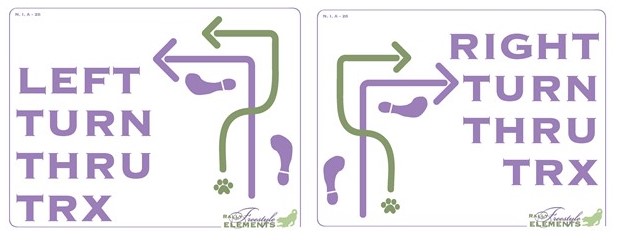
Below is video of the left and right turn transitions. The dog passes through the legs as the handler makes a left or right turn. In Rally-FrEe the dog will always start on the left for left turns and start on the right for right turns. The left and right thru transitions are sign #25 and 26. Remember the graphics are not meant as instruction, only as a symbol that correlates to the sign description:
Handler turns left (or right) as the dog
passes through the handler’s forward right leg directly into right heel.
For large dogs, handler may lift their foot or leg to accommodate
dog’s size.
Below is a compilation of the performance of these signs
In this next clip you will see the finished behavior, then how to configure the gates, and next a short coaching session so that
Note that with the gates, after clicking, I stop to feed in position rather than continuing forward.
When you make the turn is up to you, but I recommend that you make the turn as or just after the dog goes thru. If you make the turn first, the dog will have to adjust his momentum before going thru. Note in the video below, the handler makes the turn first, and the dog has to shift his momentum abruptly, once on the turn, and again to go thru. The purpose of a transition is to eliminate these abrupt shifts in momentum, so having the dog go through before or as you turn will create the flow you want.
Figure 8
The Figure 8 can be used as a main move or behavior in freestyle or as a change of side. For Rally-FrEe the figure 8 behavior is sign #27 and is always performed 2 x, with the dog passing thru the handler’s leg a total of 4 times, and finishing on the same side they started.
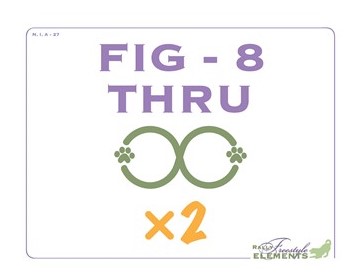
The cue is the same cue you use for your pass thru to the other side.
The below vids show the use of a target stick in training the figure 8, but often by the time the dog has worked on the single pass thru to position and the turns, and added the verbal cue, the target stick is not be necessary.
You can also start this with your legs slightly forward of each other to jump start your dog’s understanding – making it look a little more like the foundation through.
Bring your feet and legs parallel though, as soon as you see good success, as that is how the behavior should be performed - with knees under hips and shoulders.
If you like you can bend your knee from side to side to help make the opening a little larger. Handlers of very large dogs are allowed to lift their feet or legs to allow the dog to pass thru. The goal though is for the handler to keep their feet planted as much as possible and not have a lot of extraneous movement.
As with previous behaviors, you’ll start by C/T’ing the behavior of passing thru, but as that criteria becomes strong, you can start to C/T coming into position. Be sure to get some good reps in of single pass to the side, c/t. just as we did with the thru. You’ll have a tendency to want to do several in a row before clicking, especially if your dog already knows this skill. Just remember it is as much about the position as it is about the passing thru. Using the gates in a line alongside, will help the dog understand to come into a straight position next to the handler.
Thru Variations:
The “thru” behavior is one of the most versatile in freestyle. It is invaluable as a transition and its variations are numerous, used freestyle and as Free Choice behaviors in Rally-FrEe.
In addition to the signs we’ve covered (#19 and 20: thru to left heel and thru to right heel, #25 and 26: left and right turn thru transitions, and #27: figure 8 thru x 2) there are two more signs in the RF novice class: #28 and 29: walking weave x 3 and walking weave x 4. Why both? X 3 is a change of side behavior, while x 4 puts the dog back on the side he originally started on. In most cases you will only see walking weave x 3 on a course due to course size restrictions, but can still be used in Free choice behaviors or for freestyle routines.
In these behaviors, the handler continues to step forward and continues to give their singular thru cue. Because the dog has been taught to go through once and wait for the next cue, continuing forward on completion of the walking weave doesn’t result in a collision!
When performing a walking weave, the handler doesn't really "walk". When we walk, we tend to put our weight forward. In the walking weave you want to keep your weight back over your back leg. It can feel a little awkward at first, but actually gives you the most stability and looks pretty too!
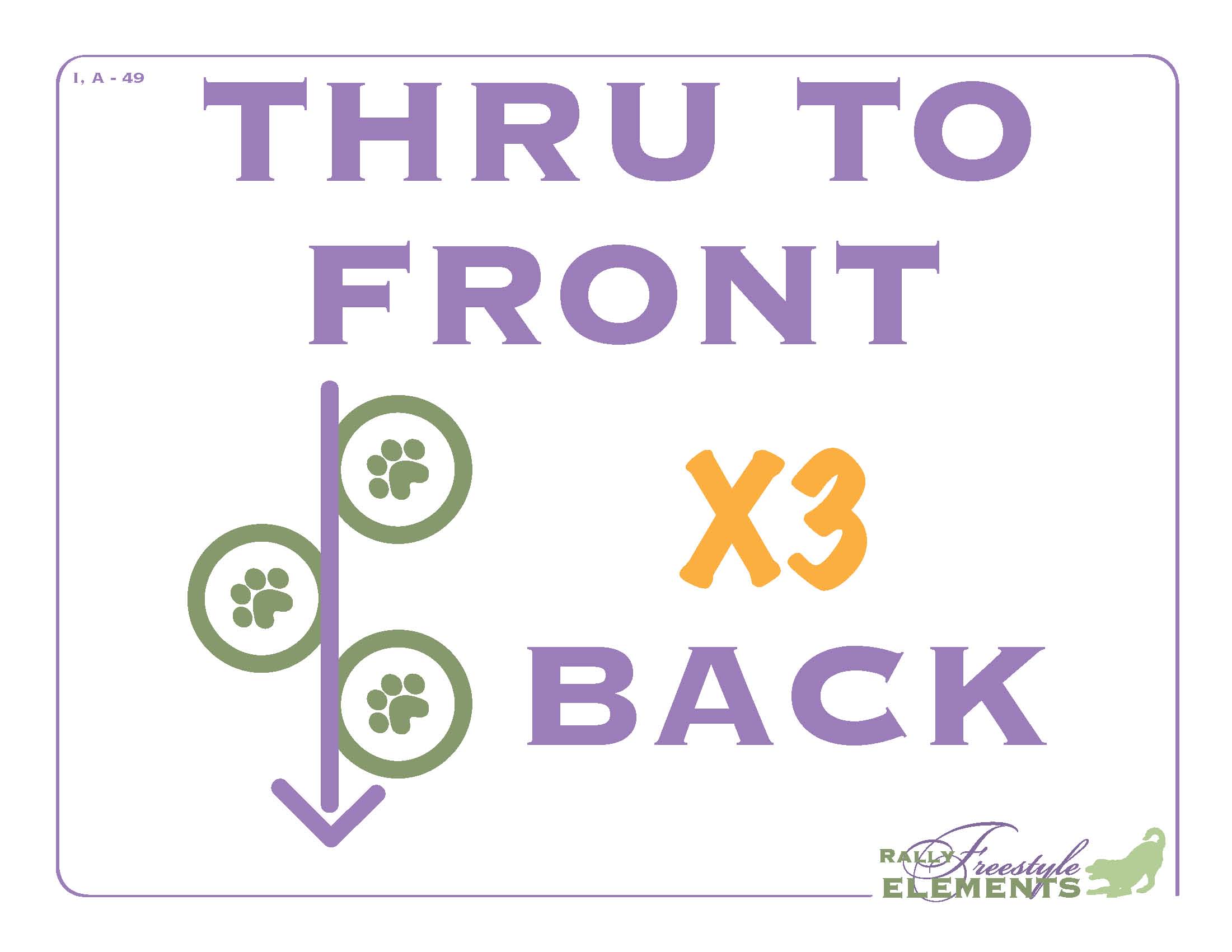
In the Intermediate class, sign #49: Thru to front x 3 back, has the handler moving backward as the dog still goes thu to the other side. The result is somewhat of a figure 8 as the handler moves back. Because there are 3 repetitions, the dog ends up on the other side of the handler, so this is a change of side sign. While this looks complicated, the dog is still performing a thru, with the same cue as all of your other "thru" behaviors.
This week I’d like you to explore the thru behavior. Most dogs learn the foundation skill of passing through the legs to the other side pretty quickly. It’s easy to build value and speed through fast food or food or toy tosses. And since the verbal cue is always associated with a physical cue, dogs readily learn to respond to the cue. This allows us a little more time to “play” and explore all of the ways this skill can be used.
Below is a compilation of variations. For most, it is the handler that has to learn something new! The dog just needs to know the cue and have a reward history for the behavior. I have found that dogs tend to really like these variations once taught. Some of these variations are more difficult than others. Study them. Most all can be learned by both dog and handler without further instruction. But as always, ask if you are not sure how to get started on these! And as always, looking forward to video!
In teaching these, as always, when we add something to a behavior, some other criteria, or make it more difficult in some way, we want to also take a step back in some way and make it easier. So if your dog struggles responding to your cue because the picture now looks different to him, then help him out a few reps to build reward history for the new way of doing things! Go back to the target stick, use a hand cue, make your reward an event to let him know how much you appreciate his hard work! In practicing these, your dog could lose a little confidence, especially if the foundation “thru” doesn’t have a strong reward history yet. So be generous in your rewards and reasonable in your criteria.
Instructor
Julie Flanery
Faculty
Julie Flanery (she/her), CPDT-KA has been working professionally with dogs and their handlers since 1993. She focuses on the needs of the dog and helping people form a strong relationship, through clear communication, and positive reinforcement. She has placed Obedience...