The first thing we need to understand is that cues are reinforcers.
Cues are reinforcing because they are opportunities, and opportunities are very reinforcing. Even if you don’t get anything yet! Just the opportunity to possibly get something can be HUGELY reinforcing (depending on what exactly that opportunity represents).
What that means for us is that *IF* a cue is a reliable predictor of an opportunity for reinforcement, the cue becomes a conditioned reinforcer.
Cue -> Behavior -> Event Marker -> +R
The cue becomes a tertiary reinforcer because it is 2 degrees removed from a primary (or unconditioned) reinforcer.
Food = Primary Reinforcer
Click = Predicts food = Secondary Reinforcer
Cue = Predicts opportunity for click = Predicts food = Tertiary Reinforcer
So because the cue is a conditioned reinforcer, it has the same power as an event marker as a click.
IN FACT (and this is really totally mind blowing, or it was for me), the *click* IS a cue. It predicts a very reliable behavior… eat food! (We can get more complicated than that, but it’s not terribly relevant for this class, so I’ll refrain.)
So every single behavior you train is actually a mini-behavior chain. Cool, right? I KNOW!
Ok, so I think it’s important to know that, while these secondary and tertiary conditioned reinforcers do require conditioning, these are natural processes that are occurring to and around us all the time.
In fact, the process of conditioned reinforcement through associative learning (which is what is underlying the chaining concept), is how animals learn to do complex tasks in the wild for evolutionary benefit. For example tool use, foraging strategies, and any behavior that must be coordinated for a period of time before the payoff (wolves hunting?). This is observable and repeated over and over again in many, many species… birds, alpacas, primates…
Crow learning a behavior chain to access food:
How conditioned reinforcers work
So at some point you have heard that because we pair a click with food, the click becomes a secondary (conditioned) reinforcer, and so eventually the click itself becomes reinforcing. This is true! However, we are talking about reinforcement in the scientific sense. Some folks may have slightly misunderstood this idea of a conditioned reinforcer, and then extended this to include clicking without treating as the way to go, because the click is now a conditioned reinforcer and has reinforcing power on it’s own.
The click is only reinforcing because it reliably predicts an opportunity for the primary reinforcement. If we turn the click into a poor predictor of primary reinforcer, by not feeding when we click, then it will quickly lose that conditioned power like a new car loses value after you drive it off the lot.
As long as the relationship between the click and the food is maintained, the sound of the click WILL act to reinforce whatever behavior is occurring at the time the click is perceived. When that relationship is broken, the click no longer reliably predicts food… it loses is reinforcement property, and can quickly become noise.
Our cues work the same way.
Different primary reinforcers (like kibble vs hotdog), have different relative values. The same also goes for behaviors and their relevant cues. The value of a particular behavior/cue will vary depending on the situation.
Take this situation for example:
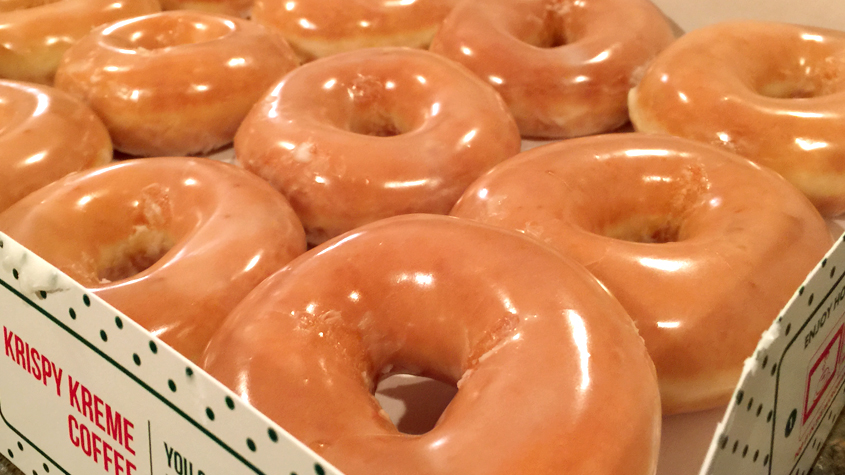
Your initial state: holding a warm Krispy Kreme doughnut + hungry
You have a limited behavioral repertoire (for the sake of this game, bear with me):
- Put doughnut in mouth
- Throw doughnut on ground
- Jumping jacks
- Running
Your brain will consider each of these options as behavioral choices in this situation, and assign values to each option. If you are a normal human, you will likely VERY quickly assign a HIGH value to choice #1, and dismiss the other choices as not advantageous.
In this case, the situation of doughnut in hand is a cue, the behavior that cue predicts is doughnut in mouth, and doughnut in mouth is a reliable predictor of JOY!
Your state has now changed and your brain assesses the new state to be an improvement over the initial state. This is good!
So this is how a single behavior is learned… and we do it all the time.
However, how did you learn to drive to Krispy Kreme, go inside, purchase a box of hot delicious doughnuts, open the box, and pick up a doughnut… so that you could find yourself in the position to make the choice to either eat it or throw it on the ground?
That is a behavior chain.
Each choice that you make in the sequence that takes you from hungry in your house to eating a warm doughnut at Krispy Kreme acquires a conditioned reinforcement value… and the value of the primary reinforcer at the end of the sequence transfers forward in the chain.
This works because each behavior that you complete within the sequence changes your state to one you associate with being closer to doughnut consumption.
State 1: Hungry at home
State 2: Driving to Krispy Kreme
State 3: Ordering at the register
State 4: Holding box of hot doughnuts
State 5: Open box of hot doughnuts
State 6: Doughnut in hand
State 7: JOY!
You know from previous learning history that each successive state is predictive. So in fact, when you make a choice, the new state functions as a cue… an opportunity to make another choice. That choice results in a change of state, and that new state is good (because closer to doughnut), and so that new state functions to reinforce the choice you just made AND as a cue to then make another choice.
You can also see that if there was a gap in the chain. If you chose to drive to Krispy Kreme, and it was closed (I know it’s upsetting to think about)… you would not find the new state that resulted from your driving to be functionally reinforcing. If you then ran a few errands and came back, and it was open, you might still get your doughnut, but you have a broken chain because the behavior of driving directly from your house to Krispy Kreme was not reinforced.
If you sat in the parking lot for a few minutes and then it opened, your chain may still function. You may simply learn to put a little duration on your parking lot behavior, because it was, in fact, reinforced. But as soon as you leave Krispy Kreme property without your doughnut, your chain has broken.
Each state only works to maintain the chain because each new state tells you that you are closer to your goal.
In behavior chain terms, these successive states are called “internal” cues, because there is no one outside your “box” giving you cues (not entirely in this case, because you likely responded to external cues in the form of traffic signals on the way).
If someone told you to drive, then park, then open the door, then order the doughnut, then open the box, then put the doughnut in your mouth… those would be “external” cues. Yes, that would be odd and controlling (and can you imagine of one of those cues were to be late? OMG!), but that’s how it would function in theory. And it might make sense if you had no learning experience to draw on that told you which actions to take to get closer to your goal.
But in either case, the cue to do the next thing reinforces the previous action. If at any point, you are left hanging… waiting for information (what do I do now?), the reinforcing value of that cue is lost. The cue (whether external from a handler or internal from a changed state) MUST occur just as you complete the previous behavior.
In performance chains, we have a combination of internal cues and external cues maintaining the chain. Many will come from you as the handler. Some will come from the dog’s state changing in the environment. “Oh! I have a dumbbell in my mouth! That’s a new state! I choose to bring it to my handler!"
And that is also why a “poisoned” cue will not function well within a chain. If the cue does not reliably predict a desired outcome, then the reinforcing value of the cue is lost.
In Karen Pryor's words, "Even though successful response to a given discriminative stimulus is still followed by reward, if failure is now followed by punishment, you have made that discriminative stimulus ambiguous in terms of predictable outcome. It is no longer 'safe.' You have poisoned your cue."