OB185 Heeling: Power and Precision - Part Two
This class is part 2 of a 3 part series.
Course Details
How do you turn your foundation heeling behaviors into formal heeling? What cues and footwork do you need for a polished performance?
In this class, we will focus on building the components of a heeling pattern:
- Starts
- Halts
- Left turns
- Right turns
- About turns
- Change of pace
Using the foundation skills, games and exercises taught in Part 1 of this series, you will build ring-ready performance one component at a time. You will focus on elements needed for a correct, full-point performance from the dog, as well as cues and footwork from the handler. You will combine the movement skills from the previous class into precise and powerful heeling for sharp turns and an enthusiastic performance.
Syllabus
**Tentative syllabus. Exact order and exercises subject to change based on progress and needs of participating teams.
Week 1
- Basic Position
- Head position in heel
- Pivot to cone
Week 2
- Pivot around cone
- Adding steps to targeting game
Week 3
- Cone-to Cone
- First step
Week 4
- Left Turns
- Right Turns
Week 5
- Getting Formal
- About Turns
Week 6
- Change of pace
- Halts
Prerequisites & Supplies
Sample Lecture
1.2 - Pivot + Cone
Objective: The dog moves around a cone to find heel position.
Once you have a fluent (meaning accurate and without hesitation) pivot into heel position on the pivot platform, it’s time to generalize the heel position concept to situations other than the platform. One of my tricks to facilitate this is to transfer the behavior from the platform to a cone (or other vertical object).
Eventually, the cone will act as both a visual cue and a guide to help the dog find and stay in heel position. Then we can work on moving around and away from the cones to get the behavior without any props whatsoever.
Note: It doesn’t have to be an actual cone, just a vertical object that takes up about a cone’s worth of space in front of your dog (or slightly taller). I have written the instructions using a cone, because all dog trainers have cones. Use a bigger cone for a bigger dog. Feel free to substitute for anything you have handy, such as a trash can, folding chair, bar stool, gumball machine, etc. A taller object will have a stronger effect, so I usually look for a cone (or cone substitute) that is at least nose height for my dog.
To teach it:
- Position the cone so that it is just in front of the platform. Stand with your left ankle centered on the platform, and your left big toe pointed to the cone. The cone will be ahead of you and to your left. (In front of your dog.)
- Start your dog on the platform, and reinforce several times in that starting position. You will need to reinforce your dog fairly heavily for not standing on the cone, because as a clicker savvy dog, he will want very badly to offer behavior with the new object. The best way to communicate that it is not necessary to stand on the cone is to reinforce a LOT for standing *near* the cone and not *on* the cone.
- Begin to play your rubber band pivot game just as before. The only difference is now there is a cone in the way. Your dog will have to go around the cone to find heel position. Don’t be afraid to revisit step 2 frequently to keep your dog from standing on or otherwise assaulting the cone.
- When he is coming smoothly into heel and most ignoring the cone, you are ready to take up the platform. Remove the platform (set it nearby, because we may be cycling through platform/no platform a few times before the concept really sticks).
- Start right from the beginning by luring the dog into heel position, and reinforcing many times right there. Just as we did when we first started teaching rubber band pivots.
- Go through your full rubber band routine, now without the platform. Be aware that your dog may still want to stand on the cone, so be ready to revisit the previous steps a few times for clarity.
- Your dog should now be moving around the cone to find heel position without the platform! You are ready to rock and roll!
If your dog has some learning history with going around cones, this will most work in your favor. However, he may offer to go the wrong way around the cone intially. That's not a big deal, and it's something he can quickly figure out. Pre-load that heel position heavily to help pull him in the right direction, and keep an eye out for what starting points are harder and which are easier for him.
***ps - This video shows a preview of moving around the cone, which we will add on next week. For now get that offered stationary position (meaning your feet stay put) really, really solid. If you feel like you've got it nailed at home, take the stationary version on the road and generalize it. This exercise is one I return to over and over again and use regularly at show & go's and formal ring situations, even (or perhaps especially) with my adult dogs who are already successfully competing.
Instructor
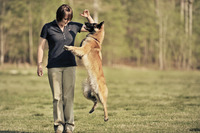
Hannah Branigan
Faculty
Hannah Branigan (she/her) has been training dogs and teaching people for more than 10 years. She is a Certified Professional Dog Trainer (CPDT-KA) and a Karen Pryor Academy Certified Training Partner (KPA-CTP). Hannah is the owner of Wonderpups, LLC, and teaches workshops...