NW420 Honing Your NW Handling
Do you wish you were a better handler? Handling is 80% dog / 20 % handler. How you handle makes a huge difference in your performance and in your pass rate.... it drives those "P's" and "Q's"!
Course Details
In this class we will be all about the details... Learn how to handle through critique.
You will learn HOW you body motion affects the dog, everything from your shoulders to the angle of your body with respect to the dog's position. You will learn the art of releasing body pressure in a way that will minimize false alerts or unintended cues. We won't be "proofing off of" body motion, but rather will learn how to use our motion and position in order to become true teammates with our dogs.
You will be presented with an entire handling system and will be taught how to handle effectively, as a teammate, without negatively impacting your dog. Good handling is the foundation of teamwork. It's a skill that takes time to hone but it beautiful to see when it all comes together!
Learn how to make it look EFFORTLESS....
Sampling of topics:
- The art of handling the known hide
- Handling in tight spaces
- Handling the fast dog
- Handling the sensitive dog
- Impact of gear choices
- How to NOT over-handle your dog
- How to get your dog out of trouble in order to avoid a false alert
- Using handler influence as suggestive, not directive
- Handling using a pattern without over-handling
- Knowing WHEN to pattern versus not pattern
- How to use a Soft Pattern rather than a prescriptive pattern
- Handling off leash like you would on leash
- Knowing when to change your strategy and how to adapt and continue
Teaching Approach
The instruction will be written with short videos of example searches. The student may need to adapt the example to their own situation. Lecture videos may run from 1 to 4 minutes long, with the average between 1-2 minutes. The lectures are designed to help a student understand the purpose of the topic and how its application might vary by dog. Care is taken so that learners who learn by both watching and reading will be successful.
This class will have a Teacher's Assistant (TA) available in the Facebook study group to help the Bronze and Silver students! Directions for joining will be in the classroom after you register.
Syllabus
Week 1: Observation
- Nosework Gear
- Line Handling Mechanics
- Observation: The Dog’s Communication
- Observation: Air Flow
- Observation: The Search Area
Week 2: Understanding Your Impact
- Why is Independence Important?
- Understanding the Impact of Body Pressure
- Understanding what you are Communicating (Body and Voice)
- Marker Basics
Week 3: The Essential Balance between Dog and Handler
- Maintaining Independence without Abdicating your Role as Handler
- When and How to make careful suggestion
- Hunting Type Searches: Context Driven (Vehicles)
- Hunting Type Searches: Non-Context Driven Searches (Area Searches)
- Selection Type Searches (Containers)
Week 4: Impactful Pieces
- Verbal Cues: What, Why, When, How
- Transition Between Hides
- Multiple Modes of Reinforcement
Week 5: Support through Odor Challenges
- Tight Spaces
- Odor Pools
- Converging Odor
- Elevated Hides
Week 6: Strategy for Coverage
- Known, Range, or Unknown Number
- Time Pressure Challenges
- The Perimeter Search
- No Go Backs!
Prerequisites & Supplies
Sample Lecture
This is a partial lecture from Week 2 Materials:
Impact of Frontal Body Pressure
Have you ever felt like you've kept your dog in one area, possibly to the point of a false alert? If so, this was probably caused by frontal body pressure.
Frontal body pressure occurs when you face your dog squarely. This type of stance communicates to the dog to more thoroughly investigate the area. One of the best ways to talk a dog into a false alert or into fringing is to face the dog square on. It's even more ineffective if you couple that body language with mild crowding or verbal prompting.
It usually goes like this:
- The handler unconsciously applies frontal body pressure
- So the dog shows interest
- So the handler shows interest
- So the dog shows interest
- So the handler shows interest
- So the dog false alerts
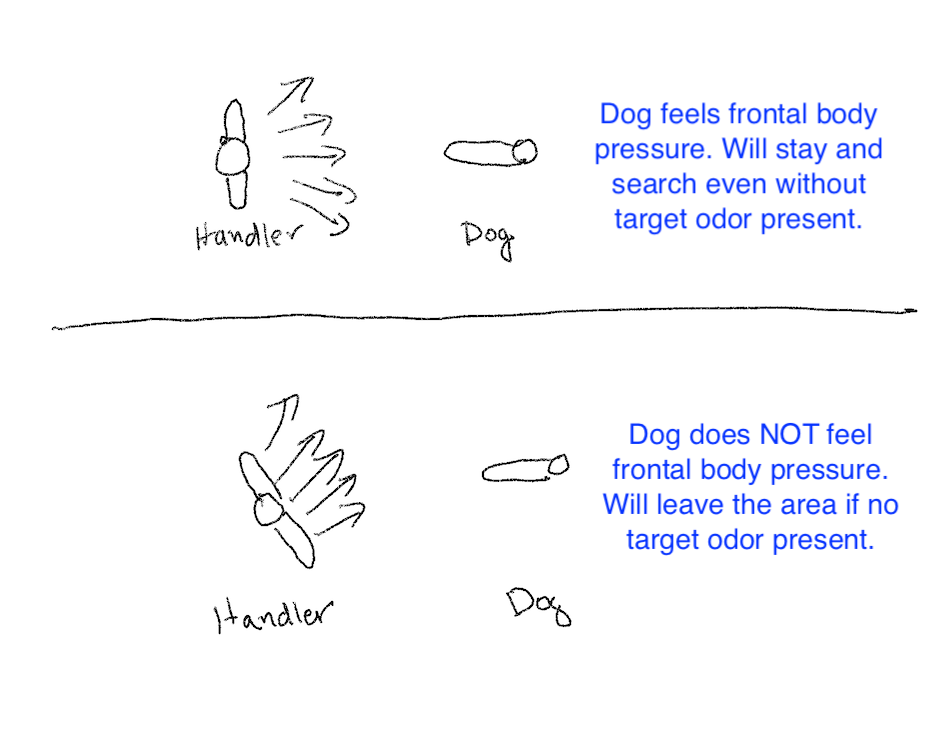
RESOLUTION: The key to allowing your dog to work independently is to turn sideways (or at an angle) and step back if necessary. You can even just position one foot back and shift your weight back.
Impact of Body Pressure on the Start Line
So often I see people lean over their dog on the start line. Sometimes this is to kiss them on the head or to whisper something to them. This shifts the focus from the search onto the handler.
Here is a video that I made of Joey showing the difference in his release to search based on upper body pressure:
Certainly this is more challenging with a small dog... but it can still be done! If you have a small dog, just try STANDING TALLER.... Here is a video of Why's start line. Notice that although I release him from the harness (that helps when you want to have directional control of the releaase), I keep my upper body tall and I look ahead. When I release him, my first motion is to stand up... my SECOND motion is to follow him in. This minimizes upper body pressure and allows Why to focus on the search.
Releasing Pressure in order to let the dog source a challenging hide
Releasing pressure is your best friend when you are working challenging hides, ESPECIALLY elevated inaccessible hides. With elevated hides, odor spreads VERY VERY FAR. By increasing your distance from your dog and by releasing body pressure where you can, you can support the dog's effectiveness and independence in problem solving. When we step in, add pressure, or stand with our two feet parallel and straight at our dog, we take away their choice in problem solving... which can often lead to a "No".
You can see in this video of Powder solving a very difficult elevated hide (that is converging under the tables with all of the other hides in the room) how I open space... watch for weight shifts back, steps back, increasing distance and stepping away from the wall.
Instructor
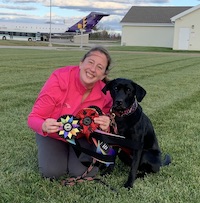
Stacy Barnett
Faculty
Stacy Barnett is both a sport and working dog handler. She is a top nosework competitor and trainer, and the first handler to put multiple Summit titles (16 so far) on 3 dogs (Judd SMTx3, Brava SMTx7, Powder SMTx6) in the National Association of Canine Scent Work (NACSW)...
Registration
Gold
$260
Available seats: 12
- Access to all lectures and homework forums discussion
- Read all posted questions and answers
- Watch all posted videos
- Post general questions to discussion forum
- Submit written assignments
- Post dog specific questions
- Post videos (unlimited)
- Receive instructor feedback
Silver
$130
Available seats: 25
- Access to all lectures and homework forums discussion
- Read all posted questions and answers
- Watch all posted videos
- Post general questions to discussion forum
- Post dog specific questions (video only)
- Post videos (up to 2)
- Receive instructor feedback
Bronze
$65
Available seats: Unlimited
- Access to all lectures and homework forums discussion
- Read all posted questions and answers
- Watch all posted videos