FE590 Out and About
This class is all about enjoying the time you spend out and about with your dog: urban walks, nature hikes, and going places. Whether you and your dog walk on leash, off leash, or on a long line, there are skills that will make your time together more enjoyable, and inspire you to take your dog out and about even more often!
Course Details
We’ll be looking at ...
+ advanced recalls
+ radius training (keeping a certain radius around you even when off leash)
+ loose leash walking (3 methods to choose from)
+ settling in public places
+ using the Look at That! game (Leslie McDevitt) to pass scary or exciting distractions
+ muzzle training
This is a great class to build on what you learned in Calling All Dogs!
Teaching Approach
Out and About is a choose-your-own-adventure course. Students pick one or more training goals in the beginning of class, and follow the respective "paths" through the class. All lectures will be released on the first day of class to ensure students get to spend as much time as they need on their respective training goal(s).
For example, you may work on designing a training plan for your dog's greatest recall challenge in week 1, and work on it over the next 6 weeks. Or you may pick loose leash walking as your first goal, select one of the methods presented, focus on it for two weeks, and then work on settling in public for your second training goal. You may also work on (mild) reactivity for several weeks of the course.
Gold students get individualized attention, and unlimited 59-second-long videos. I'm happy to help you problem-solve, brainstorm and overcome your team's specific challenges - even if they require us to think outside the box. If you're not sure whether this class is a good fit for your challenge, just send me an email and we'll figure it out together!
Gold feedback on videos is time-stamped, and each of my replies comes with a concrete next step for you to work on or submit videos for to make sure you don't get stuck.
Silver students are encouraged to use their homework thread as a training diary and accountability tool and participate actively in the discussion forums.
This class will have a fantastic Teacher's Assistant (TA) available in the Facebook study group to help the bronze students! Directions for joining that Facebook group will be in the classroom after you register.
Syllabus
Syllabus (subject to change)
After an introductory lecture, you get to choose your own adventure(s). All lectures will be released on the first day of class. Here are 9 possible paths through this class:
Adventure A: Advanced Recalls
(A1) Analyze your recall challenge and make a training plan
(A) Case study Grit: drafting Grit's training plan
(A) Case study Grit: milestone #2 (stationary toys)
(A) Case study Grit: milestone #3 (moving toys)
(A) Case study Grit: milestone #4 (live cows)
(A) Case study Leeloo: drafting Leeloo's training plan
(A) Case study Leeloo: milestone #1 (perfecting the reward ritual)
(A) Case Study Leeloo: milestone #2 (easy environment)
(A) Case Study Leeloo: milestone #3 (intermediate environment)
(A) Case study Leeloo: milestone #4 (real life)
Adventure B: Enjoyable Walks with a Leash Puller - food method
(B1/C1/D1) Enjoyable Walks with a Leash Puller
(B2) Training loose leash walking with food reinforcers: context and equipment
(B3) Training loose leash walking with food reinforcers: foundation skills
(B4) Training loose leash walking with food reinforcers: the invisible line
(B5) Training loose leash walking with food reinforcers: step by step
(B6) Training loose leash walking with food reinforcers: the real world
Adventure C: Enjoyable Walks with a Leash Puller - Circle Method (à la Denise Fenzi)
(B1/C1/D1) Enjoyable Walks with a Leash Puller
(C2) Leash Circles à la Denise Fenzi
Adventure D: Enjoyable Walks with a Leash Puller - head halter
(B1/C1/D1) Enjoyable Walks with a Leash Puller
D2 Introducing Your Dog to a Head Halter
Adventure E: Muzzle Training
(E) Muzzle Training
Adventure F: Leadership & Structure: the Look At That Game (à la Leslie McDevitt)
(F1) Leadership & Structure: Teaching the "Look At That!" Game (LAT)
(F2) Leadership & Structure: Using the Look At That Game in Real Life
(F3) Bonus Lecture: LAT Meanderings
Adventure G: Settling in Public
(G1) Foundational mat skills for settling in public
(G2) Settling in the real world
Adventure H: Radius Training
(H1) What is radius training? Do I need it?
(H2) Radius Games: Fun in the Green Circle
(H3) Radius Training: opportunity cost
(H4) Radius Training: dropping the long line
(H5) Radius Training: from structured sessions to real life
Adventure I: Leadership skills - teaching a "Let's go!" cue aka emergency U-turn
(I1) Leadership skills: teaching a "Let's go!" cue
(I2) "Let's go!" ... what if your dog can't respond?
(I3) Using "Let's go!" in real life
Adventure J: Write Your Own Adventure!
Gold students may work on a challenge individual to their dog and their training goals IF it is close to the overall topic of this class (Ask me first!) For example, past "adventure J" students have worked on:
+ Settling under specific circumstances (at a trial; in a crate; in a tent when camping).
+ They have tackled mild reactivity in public in creative ways not covered in the lectures - from food scatters over classical counterconditioning to Control Unleashed patterns.
+ Calmly getting into and out of cars to set the dog up for success at the destianation of a car ride.
+ Riding in a bike trailer.
+ Creating acceptable outlets for breed-specific needs and behaviors.
+ Stop and sit at a distance (in case something unforseen pops up between off-leash dog and handler on a trail).
+ Go to the left or right sight of the road on a hand signal and wait there until released (relevant for off-leash walking/hiking with the dog at a distance).
+ Acclimation to new and/or exciting environments.
Prerequisites & Supplies
Sample Lecture
How to Analyze Your Recall Challenge and Make a Training Plan
Do you have a strong recall in most situations, but struggle with a specific distraction? Good - you’re ready to work on an advanced recall, and tackle your big challenge!
Unlike the foundational steps for a reliable recall, advanced challenges are as individual as the dogs who are facing them. Rather than giving you a recipe to follow, I am going to help you design, tweak, and work through your very own training plan. Your plan may end up looking similar to one of the recall case studies included in this class, or it may look very different - it all comes down to what reinforcers your dog prefers, who they are, and what kind of distraction you are working with.
This lecture will give you a blueprint for analyzing your challenge, and starting to draft a training plan. Consult it in combination with the two case studies included in this class!
Blueprint for your training plan
1. What is your baseline behavior? What happens right now if your dog is faced with the distraction you would like to work on?
Put on your ethologist’s hat, and describe observable behavior! If you are a Gold student choosing advanced recalls for this class, share your description as well as a baseline video (if you happen to have one) on your homework thread. Silver students are welcome to use their homework thread for the written part of this exercise as well. Bronze students - I encourage you to write down your baseline, even if it’s just for yourself!
2. Analyze your problem in-depth!
a) Is it really a recall challenge, or does it only look like one?
Example, fence fighting, especially if it also occurs in your absence, isn’t a recall challenge. Neither is your border collie herding toddlers.
b) Is the distraction something your dog can have some of the time, or is it always off limits?
Example: other dogs are a distraction your dog can have access to sometimes. Chasing cyclists is always off limits.
c) Do you have a reward that is potentially higher value than the distraction?
Think outside the box! If you suspect a specific reward ritual might be higher value, but your dog isn’t familiar with this reward procedure yet - we’ll start by training this new reward ritual to fluency!
d) Is it realistic to allow your dog to engage in an alternative behavior that is similar to the unwanted behavior?
Dogs often display behaviors they need an outlet for. Giving them an alternative outlet for the behavior in question helps set you up for success!
Example: if your dog just loves chasing rapidly retreating objects, is there a way of integrating the behavior of chasing into their lives, or even into your recall reward? If your dog loves following animal tracks, is there a way of integrating tracking or sniffing into their life, or even into your recall reward?
e) Can you control the distraction?
If not, is there a way to make it controllable? Can you think of a controllable stand-in distraction you could use in a training set-up?
Your answers to the questions above will help you assess whether teaching a reliable recall in the face of your chosen distraction is realistic for your dog, or whether you will have to look into management options instead.
3. Define a realistic training goal and/or management solution.
Training goal:
be specific! What does the dog’s goal behavior look like to an observer?
Management component:
You may decide to work on a management plan instead of a recall. Even if you go with a training plan, you will likely need a management component as well: it is essential that the dog not engage in the unwanted behavior (ignoring your recall, or chasing something that is always off limits) while you work through your plan.
4. Draft your training plan!
a) Break your overall training goal down into smaller milestones.
Define specific criteria for completing each milestone! Criteria may include speed, latency etc.)
b) Split each milestone down into specific training steps.
For now, you may choose to just do that for your baseline to your first milestone.
c) Write down any additional relevant details concerning set-ups, reinforcers, and criteria!
Homework
- Read the first lecture in the case study series on Leeloo (chasing joggers).
- Read the first lecture in the case study series on Grit (she’d like to take a nibble off cows).
- Write down your baseline behavior in your homework thread!
Instructor
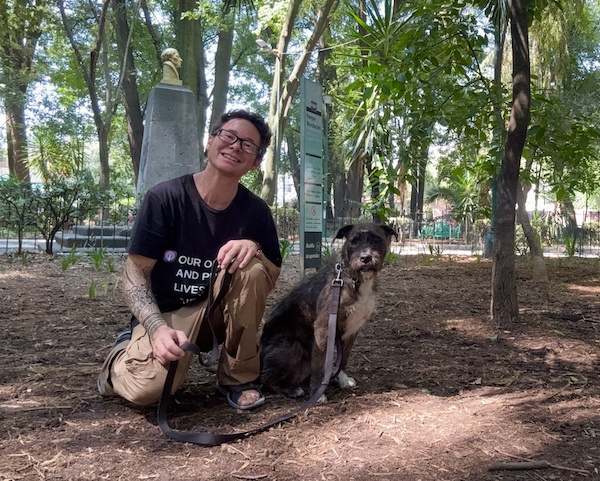
Caden Cristopher
Faculty
Caden (he/they), CCUI, is a dog trainer, writer and traveler currently based in Mexico and South America. He has been fond of dogs of all sizes, shapes and personalities for as long as he can think—especially the so-called difficult ones. Figuring out how to approach each dog as a unique individual is one of Caden's greatest passions. ...