FE580 Mission Accomplished!
One behavior, two behavior, three behavior, more! Do you ever feel overwhelmed with all there is to train? Do you love to get new behaviors started but struggle with following through and completing the process? Are there behaviors you would love to train but just don't know where to start? Or maybe you got to a certain point and didn't know where to go from there. You are not alone! The acquisition phase is often the most fun. The thrill of those first few successful sessions is what we all live for! Sometimes all we need is a bit of coaching on a specific behavior or behaviors or some help with mechanics, or an outside to see what needs to change to help you and your dog succeed! This course will guide you through the process of finishing out the behaviors you’ve started, help you get past the rough spots, keep you accountable, ensure that what you start you can finish, and celebrate with you as you shout “MISSION ACCOMPLISHED”!
Course Details
In addition to working through the behaviors you have chosen for this course, the opportunity to learn how to train other behaviors will be provided through the gold students threads and the additional lectures taken from my Handler's choice class.
Specific behaviors will be noted in the alumni group as they are identified. The gold student threads will be a significant part in the instruction of these additional behaviors including video demonstrations and will be available in your library following the end of class.
In addition: All lectures and tutorials from my "Handler's Choice" class will be added to the lectures. As students identify their needs or behaviors they are working on, I'll continue to add to the lectures so that the instruction stays in your library.
Please note, instructor area of skill does not include, Nose work, Tracking, IPO. If you have behaviors you would like to check appropriateness for class please email the instructor. This course is very appropriate for those wanting to complete behaviors included in trick training, freestyle, Rally-FrEe, TEAM, Obedience, manners and life skills! If you have questions about what you would like to work on feel free to email me!
There will be a TA in the study group for this class!
Syllabus
This Syllabus may be adjusted or added to. In addition to working through the behaviors you have chosen for this course, those you have started and would like to finish, the opportunity to learn how to train other behaviors will be provided through the gold students threads.
Specific behaviors will be listed in the Alumni Group as they are identified. The gold student threads will be a significant part in the instruction of these additional behaviors including video demonstrations and will be available in your library following the end of class.
Motivation –
What and Why?
Identifying behaviors
What are the pieces?
Why is this important to you?
Installation –
How and When?
Committing
Handler mechanics matter
Short and Sweet!
Celebration –
Hell Ya!
Leaps of Learning – are they real?
Hesitation –
Getting stuck
Avoiding frustration
Maintaining motivation
Acceleration –
Clean loops
Criteria shifts
Generalization –
Green Eggs and Ham
Realization –
Adding the cue
Mission Accomplished!
Reveals!
IN ADDITION! The following tutorials and lectures will be included in the classroom, transferred over from my Handler's Choice class:
Placing Behaviors on a Verbal Cue |
Attention and Eye Contact Starter Games |
Criteria Shifts and Clean Loops |
Transitions and Flow in Freestyle - What are they and why are they so important? |
Timing your Cues |
Fast Food and Fine Dining |
Back Chaining |
Fluency in Cues |
Rock-a-bye backs |
Heeling Duration: Hand Targets, Ping Pong and Heeling Grids |
Pivots |
Alternative Positions - "reverse" |
Removing pivot platforms |
Back Circles |
circling props opposite to create a figure 8 |
Alternative Positions - "flat" |
Freestyle! Where do I start! |
Choosing Music |
Musicality, Transitions and Flow |
Handler Interpretation |
Teachng Thru-Turn Transitions |
circle turns for heelwork |
Prerequisites & Supplies
Sample Lecture
Getting started: You signed up for class so that you can complete one or more behaviors. You likely have a list, if not on paper then floating somewhere in your head, of the many behaviors you have started and for whatever reason have not yet completed.
Your list may be short with only one or two behaviors or it may be longer! Much, much longer! The first step is to identify what those are, where you are in the process and what’s still left!
Time to get your list down on paper. For me, writing it down is the first step in organizing my thoughts and creating a plan. Writing it down is the first step in committing to completion. Sharing that list with someone strengthens that commitment.
Do you feel tired already? Just thinking about how much work there is to do? You are not alone! Training can sometimes feel over-whelming! So much to train, so little time! No wonder we have so many partially trained behaviors! There are ways though that we can use the time we have more efficiently by looking at our priorities.
When including a behavior on your “need, must, want” to complete list I’d like you to ask yourself a few questions:
What is your motivation? Are there some behaviors that are more important to you than others? If your list is on the lengthier side, we want to try to narrow that down.
Are there some that are nearing completion? Feeling a sense of accomplishment and satisfaction in completing a behavior can reinforce your desire to start on the next behavior.
Are there some that you feel you just need to get over this one hump? Maybe you have been frustrated that you aren’t farther than you are. Getting over that hump and the feeling of relief can be reinforcing as well, helping to drive you through the process.
Maybe you have one or more behaviors you are excited about training but just don’t know where to start! That excitement you feel is valuable and is part of what motivates us to train. You want those on your list!
How will you celebrate? What activity, shiny thing, or special way will you reward yourself for your accomplishment once the behavior is complete? Write it down! Make it something different for each behavior on your list. This will give you some insight as to the importance of each behavior or skill. Choosing higher value celebratory rewards for yourself often relates to either the difficulty you foresee or the importance you’ve placed on the behavior.
Upon completing your list, assess the answers to the above questions then choose which 2 behaviors from your list that want to start with. Show me what you have! Then let’s get started!
Instructor
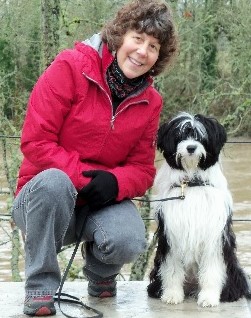
Julie Flanery
Faculty
Julie Flanery (she/her), CPDT-KA has been working professionally with dogs and their handlers since 1993. She focuses on the needs of the dog and helping people form a strong relationship, through clear communication, and positive reinforcement. She has placed Obedience...