FE545 May the reinforce be with you!
Starting from the assumption that reinforcers are behaviors rather than things, and can be trained, put on (marker) cue, proofed, and generalized like any other behavior, we will explore a large variety of traditional and nontraditional rewards for your dog: food and play, chasing squirrels, licking the dishes in the dishwasher, biting the garden hose, swimming, running out the door …
Course Details
We'll train multiple marker cues: giving different types of reinforcers and different reinforcement locations specific marker signals will maximize clarity for your dog!
Rather than just slapping on a random reinforcer, we’ll look into the state of mind it comes with, and how it affects the behavior you are rewarding: do you want action, relaxation, or calm concentration? Your choice of reinforcement matters and you will learn to make smart choices for your dog in different situations. We start with an in-depth exploration of the choice, delivery method and reward location for classic reinforcers such as food and toys, and then explore a wide array of nontraditional reinforcers.
Why should you care about expanding your reinforcement repertoire? Non-traditional reinforcers …
- help you get traditional reinforcers off your body
- lend themselves to practicing impulse control (yes, you’ll get to chase that bird - but I’d like you to do something for me first!)
- are potent rewards for life skills (Keep four paws on the floor, and you’ll get to greet your friend!)
- are lots of fun to experiment with.
This is a concept class - you can use it as a framework to practice the life or sports skills of your choice.
In this podcast episode, Caden (Chrissi), Nicole, Heather, and Melissa chat about life skills for dog athletes, and Caden gives you a sneak peak into their reinforcement class.
Teaching Approach
There will be between 3 and 4 lectures a week, released throughout the week. A lecture is approximately 1000 words in length, and will be broken up by subtitles and bullet points. Written explanations are illustrated by videos and tables (images). Homework will be provided in the last paragraph of a lecture, under the “Homework” heading.
Caden loves tailoring their approach to individual Gold teams, and tries to meet each team where they are. Their feedback is encouraging and empathic, focusing on what is going well already, and finding ways to make it even better. Caden uses timestamps to point out specific moments in Gold and Silver homework videos.
Syllabus
Preliminary Syllabus
Week 1
1. What's a Reinforcer Anyways?
2. Reinforcers as Behaviors: Train, Cue, Proof, Generalize!
3. Reinforcers are Vehicles for Emotions
4. The 3 Ts of working with marker cues: timing, tautology and treat delivery
5. What is the difference between a cue and a marker cue? Do you need marker cues?
Week 2
6. An experiment: what's your dog's cue?
7. Reward Placement and Marker Words (the theory)
8.1 101 Things to Do with A Cookie
8.2 Training a New Food Delivery Method
Bonus lecture: treat scatters part 1 - teaching scatters
Week 3
Bonus lecture: treat scatters part 2 - using scatters in real life (counterconditioning)
8.3 What's a room service marker?
Bonus lecture: A Tangent for Dogs Who Won't Eat in Public
9.1 101 Things to Do with a Toy
9.2 The structure of your reinforcement routine
Bonus lecture: reinforcement routine examples with formal behaviors and more rigorous criteria
Week 4
9.3 Training a new toy routine
Bonus lecture: Why Always Throw a Ball? Get Creative!
Bonus lecture: common schedules of reinforcement
Bonus lecture: differential reinforcement
10. Switching Back and Forth Between Food and Toys
Week 5
11.1 N-T-D Rewards Around Your House and Yard: Treadmills, Garden Hoses ...
11.2 N-T-D Rewards Around Your House and Yard: more examples, and your homework for this week
Bonus lecture: Extinction or the absence of reinforcement
Bonus experiment: reinforcement schedules
12. Thresholds: Reinforce as You Go
Week 6
13.1 Motivational states
13.2 Another experiment: the effect of motivational states
14. Species-typical behaviors as reinforcers: Digging, Swimming, Chasing …
15.1 Social rewards part 1: praise and pets
15.2 Social rewards part 2: personal play with the handler
15.3 Social rewards part 3: greeting/playing with others
Prerequisites & Supplies
Sample Lecture
2 Reinforcers as Behaviors: Train, Cue, Proof, Generalize!
Reinforcers as Things
We tend to think of reinforcers as “things”: hotdogs, tennis balls, Kongs. When we look at them as if they were objects, it’s easy to get frustrated when our rewards “don’t work”: you assume hotdogs are a reward because your dog loves eating them at home. Then you take your dog to their first group class. It’s in a building they have never been in, filled with people and dogs. It’s noisy and crowded. You brought hotdogs - but your dog doesn't eat. But … they like hotdogs at home! How can a reinforcer just stop working?!
Well - technically, it didn’t stop working. A reinforcer is defined by its effect: it’s only called a reinforcer when it maintains or strengthens the behavior that precedes it. The hotdog your dog refuses to eat is not a reinforcer in the context of the group class. It’s still a reinforcer in your kitchen, however, and in any other place your dog will happily eat.
Are you already confused? Bear with me. It’s about to get easier!
Reinforcers as Behaviors
I want you to stop thinking of reinforcers as things. Things are static. Their properties don’t change. That’s why we get confused or frustrated when our dog doesn’t play ball or take treats in all contexts. We assume that reinforcing qualities are inherent to objects - but they aren’t!
Instead, I want you to think of reinforcers as behaviors: the behavior of eating hot dogs, the behavior of chasing a tennis ball or squirrel, the behavior of chewing a peanut butter filled Kong.
What do we know about behaviors? Exactly: behaviors are flexible, and they can be learned. We need to train them, put them on cue, proof them against distractions, and generalize them to any location we would like our dog to be able to perform them.
Since you are all dedicated splitters, you know that in order to get a behavior that holds up under trial conditions, you’ve got some work ahead of you, and it might help to have a training plan:
- You'll teach the behavior at home, in a distraction-free environment.
- You'll put it on cue.
- You'll move to a slightly more challenging location - maybe your yard. Then you'll move to an even more challenging location - somewhere out and about.
- You'll train around the difficult distractions you’ll encounter at the trial you eventually want your dog to enter: you'll work around people, dogs, and noises.
You know it wouldn’t be fair to expect your dog to perform a beautiful retrieve at a big trial if you’ve only ever practiced it in your living room.
Reinforcing Behaviors vs. Obedience Behaviors
Let’s take another look at the reinforcers we just talked about. We said they were behaviors, too - so the same rules apply to them! The only reason that reinforcing behaviors are more likely to hold up under challenging conditions than, say, obedience behaviors is that reinforcing behaviors are more likely to happen to begin with. Unlike heeling - something no dog would naturally think of doing -, eating hot dogs or chasing tennis balls are likely to be offered by a dog. They are intrinsically enjoyable. That’s the reason we often get away with using reinforcers in novel locations without training for it. However, that’s not always the case.
- The lower the food or toy drive a particular dog brings to the table, the lower the probability they will eat or play in a distracting environment.
- The greater the sensitivity a dog brings to the table, the lower the probability they will engage in reinforcing behaviors away from home.
- The lower the biddability and the higher a dog's environmental focus, the lower the probability they’ll work for the same reinforcers in the presence of enticing distractions.
There’s lots of factors at play! If you’re lucky and you have a confident, biddable working dog, you might get away with lumping reinforcing behaviors - just like you might get away with lumping obedience skills. Your dog will just pick up your slack.
However, if you have the kind of dog most of us have, you’ll have to train your reinforcers like you train your dog’s other behaviors! But don’t worry - it’s doable, it's fun, and we’ll spend the next six weeks discovering and building new reinforcers for the dog in front of you!
Putting it on Cue
If you want your dog to perform trained behaviors in new contexts, you’ll need a way to ask for them: you need a cue. Without a cue, it doesn’t matter how fluently your dog is able to perform a complex trick - they won’t know whether you expect them to spin, twist, sit, down, come to front, or get you a beer from the fridge!
The same goes for reinforcing behaviors. That’s why we put them on marker cues: clicks, marker words, whistle markers, etc. The marker cue lets your dog know what reinforcement to expect, and where to expect it. Not only does it pinpoint the specific behavior you want to reinforce, but it also adds clarity to your overall training session.
We will talk about the usefulness of having a different marker cue for every reinforcing behavior you work with later on in this class. For now, just remember that putting your reinforcing behaviors on marker cues is just as useful as putting your life skills or competition behaviors on cue.
Homework
Think about the reasons your dog has trouble engaging in reinforcing behaviors in certain locations! Analyse their behavior, and share your thoughts in your homework thread! I encourage you to write down your thoughts even if you are a Bronze student. I'm going to ask you to think about a number of things over the course of this class. Now is a good time to start a training journal for your dog, and get into the habit of taking notes!
Instructor
Caden Cristopher
Faculty
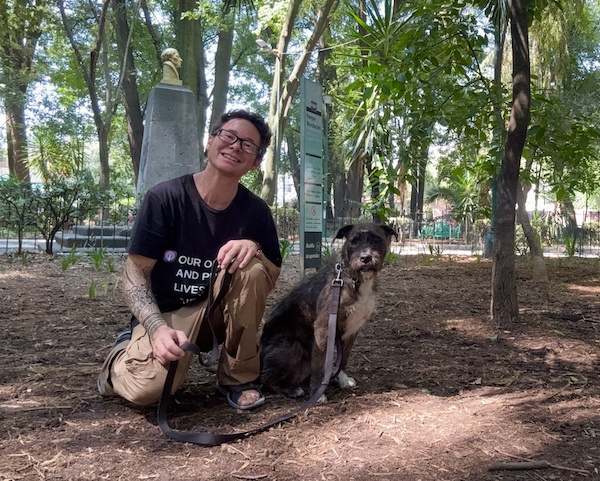
Caden (he/they), CCUI, is a dog trainer, writer and traveler currently based in Mexico and South America. He has been fond of dogs of all sizes, shapes and personalities for as long as he can think—especially the so-called difficult ones. Figuring out how to approach each dog as a unique individual is one of Caden's greatest passions. ...