FE460 Training Levels -- Level 2
If Level 1 was kindergarten, Level 2 is all of elementary school.
Course Details
Everything you and the dog learned in Level 1 now becomes more solid and more useful. You'll both be introduced to many new behaviours, with all training resting firmly on the basics from Level 1.
The "4 Ds" - distance, duration, difficulty, and distraction - will now make up a large part of your training. You can make any behaviour stronger by working on any or all of those 4 parts, and thinking about them as separate parts of every behaviour will help you remember the need to split everything you teach her into the smallest possible lessons.
Every behaviour the dog learns teaches her the actual behaviour, but there are also incidental lessons built into each Step. You AND the dog will learn to trust each other, to have faith in the performance of your partner, and to see that you can accomplish anything if you approach it in small enough steps and don't lose your cool.
In Level 2 you'll also start to see the enormous potential each behaviour has to support what the dog knows about other behaviours.
Sit and down may be different, but they each teach the dog to assume a position. Sit, Down, Zen, Focus, Lazy Leash, Go To Mat, Crate, Relax, and Handling are all behaviours that require duration - the dog must not only perform but CONTINUE to perform for a period of time.
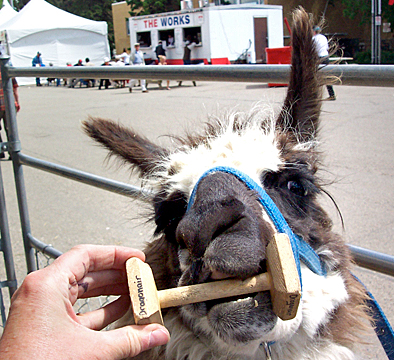
If Madrid can learn to retrieve, your dog certainly can! We're getting a firm foundation in Level 2!
Come, Sit, Down, Lazy Leash, Go to Mat, Distance and Jump require distance - she'll have to respond when she's a specified distance away from you, or go a specified distance to perform.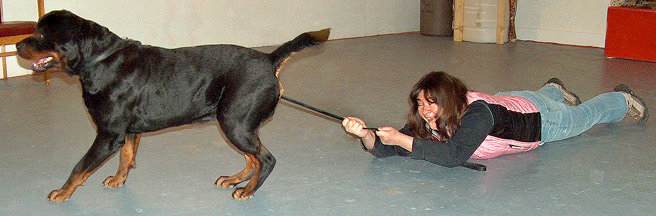
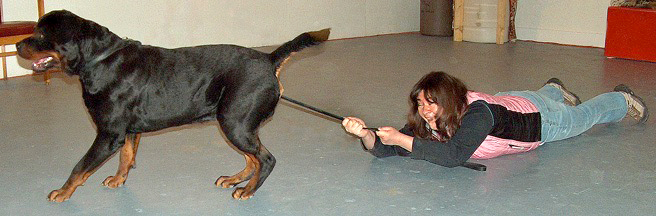
If Gabriel can learn to walk on a loose leash, it shouldn't be a problem for your sensible dog, eh?
Communication encompasses several behaviours, starting with keeping the leash untangled. All the behaviours will get harder and more useful as you work through the Steps.
NOTE: Class lecture materials are as originally prepared by Sue Ailsby who has now retired from active teaching. Sue will not participate in any of the homework or discussion forums. All class forum feedback will be handled by FDSA instructor Heather Lawson.
Teaching Approach
Lectures are released twice weekly and include written and video descriptions of the exercises in a step-by-step approach. Each skill/behaviour is broken down into progressive steps. Supplemental lectures may be provided depending on the need.
Each team works at their own pace and at a level where their dog is showing understanding and confidence with the exercise for that step. Students will be provided with both general and specific written feedback, often including timestamp referrals to their videos for clarity. Students may show their work for any previous weeks as well as the current week’s exercises for ongoing feedback.
The exercises can generally be worked in smallish spaces but will also require "other larger or outdoor spaces" depending on the exercise being worked and/or for generalization purposes
Syllabus
COME – increasing the reliability of the recall
COMMUNICATION – learning to stay out from underfoot and untangled from leashes
DOWN – increasing distance and duration on the down stay
FOCUS – beginning eye contact
LOOSE LEASH WALKING – adding distance, duration, and distraction
GO TO MAT – teaching the dog to park herself
RELAX – teaching the dog to calm herself on cue
TARGET/RETRIEVE – beginning the trained retrieve
TRICK – planning and executing a new behaviour of choice
ZEN – beginning floor Zen
Prerequisites & Supplies
FE450 Training Levels 1
If you're looking for a structured course designed to teach your dog the basic skills that every dog needs to know for success as a pet, sport or working dog, or all three, then this course is for you. This class will teach the trainer "how to teach," and how to prepare your dog to perform under increasingly challenging circumstances.
Sample Lecture
LOOSE LEASH STEP 2 - Dog and handler walk to a focal point outside.
EQUIPMENT
- Leash at least 4 feet long, collar.
- Treats and enthusiasm.
- Focal point - toy, dish, friendly person, sniffable bush - something the dog wants to get to ABOVE EVERYTHING ELSE she wants to get to.
- A place to train.
Up until now, you've been getting ready to do Loose Leash Walking. You've been explaining what's going to happen and what your dog can do about it. You've done hand Zen and floor Zen - they're part of the answer. Consider this leash Zen. You've shown your dog how to release pressure on her neck - lean away from it, take a step away from it, and it'll be gone. You've rewarded her for walking near you on your left side.
IF you've done all those things, it's time to start using them to explain Loose Leash Walking in
the real world. Here we go.
First, a warning. This DOES NOT WORK if you haven't got a focal point - something that your dog wants to get to. If she's just generally excited about being outside, it's not going to work. Trust me on this.
Look for the loading dock beside a grocery store or big box store - the place where the big trucks back in to unload their wares. These frequently have the store wall on one side and a retaining wall on the other side, then a long paved ramp from the parking lot to the loading area. This may not be a perfect setup because of the ramp, but otherwise it's perfect - nobody goes there, there's nothing to see, there's nothing to smell, and there's nothing to do.
A sidewalk between two buildings might be a good place. Or maybe just the driveway from your house to the street.
Set yourself up with a spot for your focal point (red star) on one end of your space, you and the dog in the middle, and lots of space behind you. LOTS of space behind you. You need to be far enough away from the focal object that you can still get the dog's attention with the object there. How far is that? Ask your dog. If she can give you a sit and a down with her tennis ball 20 feet away but not if it's 10 feet away, you'll be starting at 20 feet.
Get some easy behaviours from your dog - sit, down, eye contact, maybe a little giving to collar pressure. Basically, attention and willingness.
Then put out your chosen focal point. How? Whatever seems easiest. Tie the dog to a post, walk over and place it. Toss it. Get somebody else to get the dog's attention and put the thing down.
Get your easy behaviours again. Now turn and walk toward the object.
Leash still loose? Click (remember, EVERY click gets a reward!) and tell the dog how marvellous she is.
Walk a little closer.
Either quickly or slowly, your dog is going for the object. If she's going slowly, the leash is still loose. Click again! Good girl!
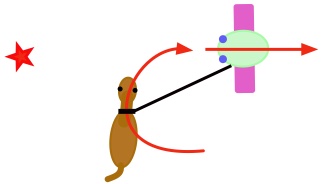
If it's fast, or if you have to take another step forward before she goes for it, when you see the leash ABOUT to tighten, BACK UP. Don't try to stop her, don't call her, don't pup-pup-pup her, don't gently creep backwards, just BACK UP. Sooner or later, she'll turn around to look at you, if only to see why she isn't going forward any more. Good girl! Get excited! Praise her! Click! Make her happy to have found your face.
There are several tricks here. First, do NOT turn around and walk away (unless backing up is going to cause you to fall and break something). Back away so she can see your face when she turns.
Second, do NOT back away one or two steps. You have to back away far enough that SHE BECOMES MORE INTERESTED IN YOU AND YOUR TREATS THAN IN THE OBJECT ON THE GROUND. That means that when you start walking forward again, your dog is with you, not jamming immediately back out to the end of the leash trying to get closer to the object.
Third, IF your dog gets to the focal point ON A LOOSE LEASH, she can have it. Yeah, I know she can't have a dead bird next week, but this is this week and this is still training and if she can get to it on a loose leash, let her have it - let her eat the hot dog, let her play with the tennis ball, let her clean your friend's ears.
Then go back and start again.
Here's what it looks like in person. Syn is 6 months old and my friend Chris is tossing wiener bits on the ground for Syn to focus on. I needed to make this video, but really, a pebble-sized bit of hot dog tossed in gravel is a pretty poor focal point! She knew she was going for it, but she really didn't have a clue where it actually was.
I know, you saw this video in the last Step of Loose Leash Walking, but take another look at it. Go thou and do likewise. Having trouble? Watch it again. Are you keeping your hands in your stomach? Are you backing up BEFORE the leash gets tight but when the dog is definitely about to go for it? Are you happy to have her coming back to you? Are you backing up far enough to get her mind off the object long enough for you to start walking forward with a loose leash again?
Key points -
- The dog needs to be willing to work with you before you start walking toward the object.
- You need to reward the dog for coming back toward you. Make it exciting. It's a GOOD thing.
- Your dog may try to make eye contact as you're walking back toward the object again after backing away. That's wonderful, but it's NOT NECESSARY. This is Loose Leash Walking - the criteria isn't heeling, the criteria is that the leash is loose - the snap is hanging straight down from the collar. That means you're clicking when the leash is loose, not only when she's looking at you.
What's the difference between this Step and what you were doing in the last Step with the open door? Absolutely nothing. It's the same behaviour. All we did was move it outside and start using it on more specific items than "other side of the door".
TRY IT COLD
Leave a treat or a ball or a squeaky toy or a friend on the sidewalk. Walk out the front door (click for loose leash), approach the object. If she gets to it on a loose leash, have a BIG party.
COMEAFTERS
Other objects. Other places. Work outside the fence of the dog park if she needs to head for dogs. Other people if she's a people-lover. Many different toys in many different places.
Think of places you go where she pulls. Work on those. Does she pull you to the car when she knows you're going somewhere? Work on that. Does she pull you into day care or into a training building? Work on that. Note that you don't have to be going into the building to work on GETTING to the building! If she's ball crazy, play near tennis courts.
Instructors
Sue Ailsby
Faculty
Susan Finlay Ailsby (she/her) has retired from active teaching for FDSA. She is a retired obedience and conformation judge. She has been "in dogs" for 54 years, having owned and trained Chihuahuas, miniature pinschers, miniature longhaired dachshunds, Australian cattle dogs, miniature schnauzers, giant schnauzers, and Portuguese...
Heather Lawson
Faculty
Heather Lawson (she/her) is a Certified Professional Dog Trainer - Knowledge Skills Assessed (CPDT-KSA) and also a Karen Pryor Academy Certified Training Partner (KPA-CTP), a CGN evaluator and a free-style judge. She has been training dogs and their humans for more that 20 years after deciding that...