FE450 Training Levels - Level 1
If you're looking for a structured course designed to teach your dog the basic skills that every dog needs to know for success as a pet, sport or working dog, or all three, then this course is for you. This class will teach the trainer "how to teach," and how to prepare your dog to perform under increasingly challenging circumstances.
Course Details
Sue Ailsby's Training Levels are being used by pet trainers, sport instructors, and working dog schools all over the world. Now you can let Sue's program guide you through them!
The training levels are designed to create a training base for ALL dogs. There are four Levels with behaviours designed to teach both dog AND trainer. Every lesson supports later lessons, with early behaviours taught, diversified, and proofed to provide a solid foundation for all later lessons, be they pet, sport, or working behaviours.
The focus of this course is not only the actual behaviors taught; the core is teaching YOU how to ensure that your dog can still perform under distracting conditions and when the "picture" looks different. We'll take a variety of basic behaviors (which we'll teach for those who need them and expand for those who have them) and teach you how to get them under a wide range of circumstances. In a nutshell, proofing, and generalization!
No matter what the future has in store for your dog, there are basic skills that will make both your lives easier, if your dog can perform them reliably under a variety of circumstances.
For example, a good pet needs to know how to be handled, to be groomed and cared for. She needs to come when she's called, to park herself on a dog bed and stay there while you eat or have visitors. She needs to ride calmly in a car, to stay away from your food, and...a few tricks to impress your friends wouldn't hurt either.
In addition, a good pet trainer needs to know how to apply the principles of training to new problems that crop up.
A good sport or working dog needs to be able to handle distractions, to stay focused on her performance, and to quickly and cheerfully learn new skills as you progress through the levels of your chosen sports
This class is the "correct" choice for almost anyone who wants to develop their dog to her fullest potential; regardless of future career path!
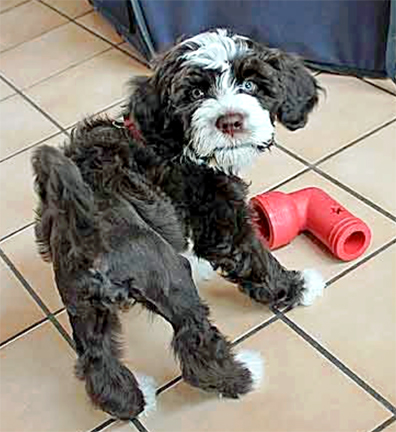
School? Already? Will that be fun?
Oh my yes, little one! You have no idea how much fun we're going to have!
NOTE: Class lecture materials are as originally prepared by Sue Ailsby who has now retired from active teaching. Sue will not participate in any of the homework or discussion forums. All class forum feedback will be handled by FDSA instructor Heather Lawson.
Teaching Approach
Lectures are released at the start of each week with the majority of lectures released within the first 4 weeks. The lectures are broken down by each skill; highlighting multiple parts. Each lecture has the objective of the exercise, applications followed by written instructions, and video examples for each of the steps. The videos are generally 1 to 2min long and show actual training sessions. No voiceover is used during the video however, subtitle explanations are part of the video content. Homework summaries can be found at the end of lectures.
Syllabus
WARNING: this class starts easy, for dog and for trainer. It STAYS easy for both - but it does take more time as it goes along!
ZEN
- dog moves away from treat in No hand
- dog stays away from treat in No hand for 5 seconds
- dog stays away from treat in open hand for 5 seconds
- dog stays awy from treat in dog dish
- increasing duration, difficulty, duration, distance
COME
- dog looks for treats at trainer's feet
- dog runs 10 feet between two people
- dog plays the Come Game 10 feet between two people
- dog plays the Come Game 20 feet between two people
- dog plays the Come Game 10 feet between two people for different rewards
SIT
- dog sits with leash off
- dog sits on hand signal
- dog sits with leash on
- dog sits by open door
- dog sits with no treats on trainer
TARGET
- dog's nose to Yes hand
- dog targets high and low
- dog moves 3 steps to target
- dog touches twice for one treat
- Station or the Bucket Game
DOWN
- dog downs with leash off
- dog downs on hand signal
- dog downs on mat
- dog goes to mat to down
- adding duration, difficulty, duration, and distance to mat downs
BEGINNING LOOSE LEASH
- dog is rewarded in The Zone
- dog moves away from collar pressure
- dog and handler move 3 steps away from collar pressure
- dog walks 3 steps with turn
- dog walks towards focal point
Prerequisites & Supplies
Sample Lecture
TL1 TARGET STEP 4
EQUIPMENT
- Your Yes hand.
- Clicker and treats.
TARGET STEP 4 - The dog targets your hand twice to get one treat.
This is a big step. Your dog is about to realize that every behaviour doesn't get a click. Sometimes she has to work harder to make the click happen.
First, a little philosophy. EVERY SINGLE CLICK GETS A TREAT. I've said that before - unless, of course, you click her for biting somebody, or for peeing on the rug. Then you just apologize (oh, sorry, didn't mean that one) and move on. Otherwise, though, EVERY SINGLE CLICK GETS A TREAT. Click means YOU DID IT! Now you're done! Congratulations, here's your treat!
Here's how you move on - every single BEHAVIOUR doesn't get a CLICK, but every single click gets a treat.
Get her started touching your hand. Get that often enough and enthusiastic enough that you know she's really in the game, having a good time with this simple thing (look, Binky! I can make mom give me a treat! All I have to do is bop her hand!).
When she's in full bop mode, "forget" to click once. A look of annoyance should cross her face, and then she should give you what I call the "Hey Stupid" reaction - Hey! Stupid! I TOUCHED YOUR HAND! Didn't you notice? Here, let me show you again. Pay attention this time, eh?
And she'll bop your hand again. Actually, she'll likely bop it harder, but harder or not, you've now gotten two bops for the price of one. Click and treat!
Bop click treat.
Bop click treat.
Bop click treat.
Bop click treat.
Bop click treat.
Bop. !! BOP! click treat.
Bop click treat.
Bop click treat.
Bop. !!! BOP! click treat.
And so on.
If she doesn't give you that second bop, you need to Chute! and do more singles, then try the double again.
TRY IT COLD
Without the warmup, ask for the bop, wait for the second one, click, treat.
CUES
I try to use a voice cue for each touch. The presence of your Yes hand is, of course, her main cue.
COMEAFTERS
Start from scratch. Teach her to touch your foot instead of your hand. Can she touch the end of a stick? When I started teaching llamas to touch the end of a stick (for shows, because it's very difficult to lure an animal with your hand when her neck is four feet long!), I wrapped coloured tape around the end. Turns out that wasn't necessary. If you click for touching the END of the stick, any animal is smart enough to aim for the end. How would you teach her to touch a wall?
Can she touch your hand three times for one click?
Instructors
Sue Ailsby
Faculty
Susan Finlay Ailsby (she/her) has retired from active teaching for FDSA. She is a retired obedience and conformation judge. She has been "in dogs" for 54 years, having owned and trained Chihuahuas, miniature pinschers, miniature longhaired dachshunds, Australian cattle dogs, miniature schnauzers, giant schnauzers, and Portuguese...
Heather Lawson
Faculty
Heather Lawson (she/her) is a Certified Professional Dog Trainer - Knowledge Skills Assessed (CPDT-KSA) and also a Karen Pryor Academy Certified Training Partner (KPA-CTP), a CGN evaluator and a free-style judge. She has been training dogs and their humans for more that 20 years after deciding that...