FE360 Achieving a Balance Between Motivation and Control
Imagine if you could build the perfect dog. Always ready to train, yet always under exquisite control. In this class we will explore all the variables that have an effect on your dog's level of motivation and control. In particular, we will consider what we can do through training and management to influence those factors.
Course Details
We will talk about the influence of genetics and take a very close look at your dog's innate temperament; what he brings to the table based on heredity. Accepting that our dogs all have certain strengths, weaknesses, and limitations is the first step to helping them meet their full potential.
We will also consider the importance of environment and experiences, and what we can and cannot control. We will work with the tools we have available such as the thoughtful monitoring and conditioning of emotional responses and the skillful use of primary & secondary reinforcers to alter arousal levels.
In this video I'm working on increasing both motivation and control at the level appropriate for this dog. The same exercises can be customized for each individual dog's needs.
Syllabus
Achieving a Balance Between Motivation & Control Syllabus
Week 1:
Genetics lecture
Diagnostic questionnaire
Baseline play & training videos
Your dog’s ‘tells’ written assignment
Skill x emotional comfort stages exercise
Week 2:
Environment & experiences lecture
Markers & primary reinforcers lecture
Marker choice & mechanics exercises
Arousal modulation: ready cue,
releases, & end of session cues exercises
Week 3:
Classical conditioning & arousal states lectures
Energize! lecture
Energy exercises:
Toss your cookies
Toy play
Personal play
Week 4:
Control lecture
Impulse control exercises:
Slow treats
Zen hand (closed & open)
Zen bowl
Floor zen
Toy zen
Tossed food & toys
Mat work
Week 5:
Most & least favorite behaviors
Most consistent behavior
Lecture: Control of Emotions & Behaviors:
What we can and cannot control
What our dogs can and cannot control
Focus Games
Week 6:
Lecture: Go with the Flow! (6)
Energy session
Control session
Energy + control session
Prerequisites & Supplies
Sample Lecture
Lecture: Control! (4):
Our ultimate goal is to help our dogs develop self-control as opposed to us exerting external control. External control can be physical (holding a dog by the leash or collar), verbal (using trained cues to alter the dog’s behavior), pressure based (verbal or physical insistence from the trainer) or space based (purposely controlling distance thresholds).
To be most useful self-control needs to be offered by the dog rather than insisted upon by the trainer. We rarely use cues for self-control. Instead, we set up a variety of situations where self-control is highly reinforced. We want our dogs to generalize the idea of self-control and offer it when they find themselves in situations where it will work in their favor. How can self-control work in your favor? That’s the key to success! Self-control MUST lead to desired outcomes. It has to be worth the effort. Giving up the obvious temptation has to quickly lead to an even better outcome.
Here is an example of a classic psychological study in self-control, the marshmallow study. This research suggests that there are preexisting individual differences in the amount of self-control that kids will display.
They really put them to the test here, and leave them with the marshmallow for 15 minutes. The purpose was not to change their behavior, but to see how long they could resist. As educated trainers, we know that this approach would be ineffective in changing behavior. We would want to reinforce control very quickly.
In terms of the overall outcome of this type of study it was determined that the kids who showed the most self-control ended up having better overall outcomes in a number of areas as they grew and developed. Being able to control yourself in tempting situations allows you to be more successful in a variety of ways.
Exerting willpower is not only difficult, but it is a limited resource. There is lots of psychological research on this topic and it all points to willpower as something that can be quickly used up. The good news though, is that we can strengthen it through the right type of training. It’s not about simply denying what your dog wants. That leads to conflict and frustration for both dog and trainer. It’s about setting up self-control challenges where the dog is mildly tested, yet quickly wins. And when your dog becomes proficient at any given level, then challenge is increased. Over time, this approach will build up a resistance for succumbing to temptations.
One other related issue to address here is the difference between control and calm. These are definitely not the same thing. A dog can be controlling himself, yet be highly aroused and energized. Think of a highly motivated agility dog on the start line. He may hold his stay until released, so he has controlled himself, but he is definitely not calm, and you wouldn’t want him to be. It is also possible to be calm, but not exhibiting self-control. A dog can quite calmly enjoy the sandwich you left on the coffee table. Control refers to an external mastery of action and behavior. Calm refers to an internal arousal state. These are two very different things. They can interact and sometimes they occur together, but not always. We can work on control with training based on operant conditioning, but calm, being an internal state that relies on a variety of variables, falls back into the realm of classical conditioning.
We will be using your dog’s desired reinforcers to serve as challenges and distractions for impulse control training. The things your dog wants are the things that he will learn to resist until given permission for access.
Instructors
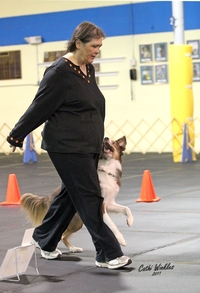
Deb Jones
Faculty
Deborah Jones, Ph.D. (she/her) is a psychologist who specializes in learning theory and social behavior. She taught a variety of psychology courses at Kent State University for the past 20 years. Deb has been training dogs for performance events for the past 25 years and was an early...

Judy Keller
Faculty
Judy Keller (she/her) has owned and trained Shelties for more than 20 years. She has been most successful with Morgan, her once in a lifetime dog. Judy and Morgan represented the United States three times in world agility competition, and were on the gold medal winning mini dog team in 1998. (Click here for full bio and to view Judy's upcoming courses)...