FE340 Beyond the Basics: Shaping Advanced Skills
We hear it all the time! "Shaping is hard!" "Shaping is boring!" "I don't have the patience for shaping!" "My dog doesn't like shaping!" We totally disagree! Shaping is the MOST FUN ever! The problems we see are typically errors of execution and faulty mechanics. Little things make a huge difference in terms of your success with shaping. Let us help! If you have tried shaping and dismissed it as too difficult or simply ineffective, let us change your mind!
Course Details
Our goal with this course is to help you take YOUR shaping skills to the next level!
If you have a basic understanding of how to shape simple behaviors and you'd like to make shaping more useful in your training, then this course is for you. Learn how to add effective shaping to your training repertoire!
We will work on your mechanical skills as well as shaping speed, enthusiasm, precision, and accuracy into your dog's behaviors.
We want to help you see the places in your training where shaping would be an advantage and then help you apply it properly. While people often use shaping for tricks, they rarely take advantage of it for their performance and sport training.
This is a GREAT class if you're short on time, have a small training space, or can't get out due to bad weather!
While we will ask you to choose one main shaping subject you can also feel free to work with additional animals during this session. Working with a variety of animals can really sharpen your training skills. Any species is fine.
Syllabus
Beyond the Basics: Advanced Shaping Skills
Pre-Class Lecture:
Selective reinforcement
Why shaping? Why NOT shaping?
Making operant subjects
Module 1: Basic concepts
Active vs. calm markers
Active vs. stationary behaviors
Setting up a successful session
Props vs. body movement
Proper technique
Treat placement
Jackpots
Skill Challenge 1: Human Shaping
Module 2: Targeting
Touch this with that!
Skill Challenge 2: What's the Target Behavior?
Module 3: Retrieves
Pick up all the things!
Skill Challenge 3: What's YOUR Target Behavior?
Module 4: Precision & topography (heeling & positions)
Do it exactly like this!
Skill Challenge 4: What's Your Criteria?
Module 5: Duration (stationary work)
Do nothing for longer!
Skill Challenge 5: Duration without Frustration
Module 6: Trainer’s Choice & Instructor’s Challenge
Skill Challenge 6: Best Laid Plans
Prerequisites & Supplies
Sample Lecture
Module 5: Duration
Do nothing for longer!
Building duration is most difficult for dogs who have learned that shaping always means doing something active. The concept of doing nothing, or simply holding a position, doesn’t make sense to them.
Once you have shaped the basic behavior and are building duration it is vitally important to reinforce often. A high rate of reinforcement tells your dog he is doing the right thing. If you withhold reinforcement for too long it gives your dog time to think, and then he starts to try some different variations of behaviors. So, as soon as you see your dog go into “offering mode” you need to increase your rate of reinforcement for stillness.
Using a variable duration reinforcement schedule will allow you to build up the time your dog holds a position while keeping motivation and interest high. Rather than constantly increasing your requirements you are bouncing around for each repetition. Some shorter, some medium length, and a longer one here or there. Too many short durations won’t improve your dog’s performance. Too many long ones will lead to repeated failure. Mixing it up and being unpredictable is the best way to go.
When working on duration all other criteria should be low. So reduce distractions and distance while increasing duration. Once you have a reasonable amount of duration add those back in one at a time.
If your dog makes an error while you are working on duration release him from the position, reset, and start again with a faster rate of reinforcement. If he continually breaks position then something is going wrong and we need to take a look at it carefully.
Class exercise 5A:
Take a behavior that you’ve taught that doesn’t have any or much duration, possibly some sort of target behavior. Practice increasing duration with this behavior.
Adding duration to a down on side:
Adding duration to focus with distraction:
Class exercise 5B:
Choose an obedience position (sit, down, stand) and work on increasing duration with this behavior.
Adding duration to the stand:
Instructors
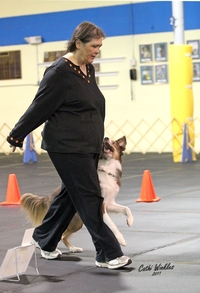
Deb Jones
Faculty
Deborah Jones, Ph.D. (she/her) is a psychologist who specializes in learning theory and social behavior. She taught a variety of psychology courses at Kent State University for the past 20 years. Deb has been training dogs for performance events for the past 25 years and was an early...

Judy Keller
Faculty
Judy Keller (she/her) has owned and trained Shelties for more than 20 years. She has been most successful with Morgan, her once in a lifetime dog. Judy and Morgan represented the United States three times in world agility competition, and were on the gold medal winning mini dog team in 1998. (Click here for full bio and to view Judy's upcoming courses)...