FE115 Baby Genius
Raising a puppy is the lucky job we get to enjoy only once in a while! The time goes so quickly, and when the time is up the opportunity to play the baby games with the clean slate is gone!
Course Details
The class is designed for puppies up to 10 months of age but any dog who needs help with foundation behaviors and life skills can benefit. This class is useful and full of adorable smart puppy videos!
The course will cover many things that all dogs need, like impulse control, mat work, cooperative play, cueing arousal states up and down. Your puppy can learn to put his own collar on, recalls and crate manners, etc. And we will also teach concepts that benefit all performance dogs, like steering, teamwork in motion, balance and coordination, using and switching reinforcements, recalls, cone games, value for work and personal play.
Take this class if you have a baby or if you think you might get a baby this year. Give this class as a gift to your friend who is getting a puppy. Take this class to get new games to play with your older dog or your fearful dog or your rescue, any dog who can benefit from baby steps. We will be playing games and building concepts related to a lifelong rewarding relationship between you and your special puppy. We will help our puppies meet the big world with Confidence and Empowerment and Curiosity and Optimism!
Baby Genius will help your puppy meet challenges with an open mind and a brain that wants to engage. When your dog of any age learns to expect that new things will be FUN, you have a brilliant head start on any sport you want to play and lots of the life skills you'll need your dog to have. You will create a problem-solver who not only expects to win but also expects to enjoy himself.
This class is a great project for building a sturdy foundation with your puppy or older dog. It is also a great class for small spaces. We do not need to travel and we do not need to own fancy equipment. Creativity is the best way to generalize concepts, and we will be very creative! We'll use classical conditioning and operant training. We'll build lots of skills and concepts for dog sports and an active life with you.
If you want a class that will let you enjoy your puppy immensely as you make him smart, resourceful, and ready to be your teammate, then this is your class!
Teaching Approach
There will be multiple lectures per week in this class, published throughout the week. The skill-building exercises in this class are presented as games. We will meet the puppy's style of interaction, so different Gold students will receive different advice. Our highest priority is to create a bonded relationship and good feelings about important life skills. We will be creative and open-minded about how to do that for each puppy.
Syllabus
WEEK 1
- Musical Toys
- Name Game - Classical Conditioning
- Recall Games - Operant Conditioning
- Zen Game of Face
- Mat Work – Love the Mat
- Name Discrimination – Treats in Turn
- Physical Restraint
WEEK 2
- Collar Games
- Crate Dates without Coercion
- Separation Game – I'm Right Here
- Mat Work – Seek the Mat
- Recall Explosions – GO!
- Affection and Touch
WEEK 3
- Come and Get It Game
- Separation Game – I'll Be Right Back
- Mat Work – Own the Mat
- Impulse Control – When to GO!
- Handler's Face Game – Which Side?
- Games for Noise
WEEK 4
- Taking Turns – Last One Wins
- Mat Work – Send to Mat
- Wanna Trade Game
- Perch Work – Front End Awareness
- Games for Balance
- Target Training
WEEK 5
- Put Your Own Collar On
- Mat Work – Take It on the Road
- Games for Relationship
- Play With Your Food!
- Ladder Work – Hind End Awareness
- Intro to Cookie Jars
WEEK 6
- Cookie Jar Games for Babies
- Tug Games and Manners
- Puppy Puzzles and Snuffle Mats
- Advanced Impulse Control Games
- Find Your Person
- Cueing Arousal States with Mat, Food, Toys, Touch, and Play
Prerequisites & Supplies
Sample Lecture
RESTRAINT MANNERS FOR BABIES - Asking to Get Down, by Julie Daniels
I am not a person who trains my little one to come up and sit politely at a very young age. I err on the side of effusive greetings while the baby is very young. Pure glee about people. I want that strong response whenever the baby sees people. I don't want the attraction to be tempered by responsibility. Yet.
So my babies go barreling up to anyone and are generally a happy nuisance while they are small. We'll do a lot more with manners and polite greeting, including the neat tuck sit in front that is so useful for life skills as well as competition obedience. But let's not go there just yet. I want to show you one of the very first politeness exercises which I enjoy with my puppies. This is a combination of self-control and cooperation which a very young puppy can learn and use to advantage.
When it's time for a little active self-control, say 10 weeks or so in my book, I begin with something very simple and extremely useful for those later “hurry up and wait” activities in all dog sports.
I show the puppy how to train me to put them on the ground when they want to get down.
Babies have a tough time of it in the arms of humans. It's safe and comfy, but they have no say in what they get to touch and what they get to explore while they are being confined in our arms. So after awhile a kid just wants to get free. A kid wants to explore some more from ground level. How to tell the people. How to get away. They whine and squirm, and if that doesn't work then they bite and struggle.
If you think about it, those are about the only ways which the puppy has to tell us he wants to get down. So I say we work with that. Rather than force the pup to be quiet in our arms, we can be sympathetic without creating a brat. We can make a training session out of putting the puppy down, many times a day. It's easy, and it is the beginning of a cooperative team effort which benefits us for life. The puppy learns that his needs will be met, and the puppy learns to be polite about getting what he wants.
I ask the baby to be soft and relaxed while I put him down. Puppies squirm in your arms when they want to get down. I know people who don't allow that, but I welcome it. I feel that it is about the only way the puppy can tell me that he is ready to explore. And I want the puppy to learn to operate on his world; that is, I want him to want to get down!
But I do not want the puppy to scrabble all the way to the floor. To instill some manners, I start by bending over (or you could sit in a chair) holding the puppy, and then I lower him smoothly to the floor. Unless he squirms, in which case I stop lowering him and instead I pick him up again. It only takes about two seconds to lower him to the floor from my bent-over position. That is only two seconds of self control of his feet. This is not difficult, but it is counterintuitive! So the first reps can take a while.
As days go on, I stand more upright and take longer to lower the puppy, each time standing up again and cradling the pup again if he squirms. In other words, I want to teach the puppy this: "I will put you down because you squirm, but I will not put you down WHILE you squirm." The puppy has to control his feet on the descent. This is something that a baby can learn to do.
This video of my Koolaid at 3 months old shows you how it turns out. This is a terrific lesson for a puppy. At a very young age your puppy can control his feet to get what he wants, and he can see it coming so he can measure his success. He is controlling his feet in order to control his freedom. See what you think. This is Koolaid demonstrating as a three-month-old. At three months she had this game down cold, several seconds. She owns that game, even though she is a very busy puppy whose feet never stop moving.
Check out her relaxation response on lowering! She makes it clear that she knows how to get what she wants, and she knows how to control her feet. And then see her immediately spring to action when she feels her paws on the floor. I promise you that if she can do it, your crazy puppy can do it too! This simple game will set the stage for lots of “wait, then explode” games later in his sports life as well. This is a great first impulse control game for the very young.
Koolaid How to Get Down
Koolaid still, a year later, is polite and relaxed about being picked up and lowered to the ground. You'll be very glad if you add this relaxation response to your handling.
I have variations for older pups and bigger pups! Let's talk about it!
Julie Daniels
Deerfield, NH
Instructor
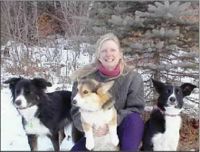
Julie Daniels
Faculty
Julie Daniels (she/her) won her first award for writing in the fourth grade, and she was training dogs long before that. Today Julie Daniels is one of the foremost names in dog agility in the United States. She was one of the early champions of the sport and helped many clubs throughout the country...