RA500 Foundation Skills for Rally-FrEe and Musical Freestyle
Rally-FrEe is a unique sport developed in 2012 that blends the structure of Rally with the creativity of Musical Freestyle. Originally designed to improve accuracy and precision in freestyle routines, it has since grown into a standalone sport enjoyed by dog sport enthusiasts around the world. Competitors can participate in both live and video events. To learn more, visit www.rallyfree.com.
Course Details
Both Rally-FrEe and Musical Freestyle rely on strong foundation skills. These skills help dog and handler teams progress more confidently and efficiently as training becomes more complex. One key focus is transitions—especially those that return the dog to a position. Transitions allow the team to change direction or position smoothly, without interrupting the dog’s momentum. In this course, we’ll build confidence and precision in these foundational behaviors, using clear criteria, structured shaping, and environmental setup to support success.
Another core element of both sports is teaching behaviors on verbal cues, rather than relying on hand signals. We’ll walk through a step-by-step process for adding value and clarity to your verbal cues, helping both dog and handler avoid cue dependency.
Our primary focus will be on foundational skills such as circling from left and right, about-turn transitions, spin to position, pass-thrus, paw lifts, and how to build variations, transitions, and full moves from these elements. Many of these same skills were later adopted into AKC Rally’s Masters class.
This course is ideal for anyone curious about Freestyle or Rally-FrEe, and for instructors looking to add these sports to their curriculum. Whether you're exploring something new or deepening your current training, you'll find practical tools and plenty of inspiration here.
Here is an example of a Novice course!
Here is an example of a "Novice Skills Test" where you can earn a title in one pass!
And here is a compilation from a variety of levels
Teaching Approach
Each week will have multiple lectures. Most will be released on the first day of the new week. However some may be released a little later in the week to allow for a progression of skills. Lectures include written and video descriptions of each exercise in a step-by-step approach. Lectures and exercises start at a foundation level and take you through the process to use the skills in a variety of ways. Supplemental lectures may be provided depending on need.
Homework and troubleshooting are listed in a separate lecture for easy access.
Video demonstrations of the exercises include the instructor's personal training sessions as well as actual students working the exercises. There are a variety of breeds and sizes represented in the demo vids. Demonstration video length varies between 1-2 minutes. Many of the demo videos are captioned.
Each team works at their own pace and at a level where their dog is showing understanding and confidence for the exercises for that week. Each week contains several exercises depending on dog and handler skill level and need.
Students will be provided with both general and specific written feedback, often including timestamps for clarity. Students will be able to show their work for any previous weeks as well as the current week’s exercises for continued feedback.
There are alot of skills and material in this course. While some students will complete all course material, there is no expectation that all skills/behaviors will be completed within the 6 week course. However the detail of the lectures and exercise videos will allow students continue the process and complete the skills on their timeline through their library.
Most all exercises, especially the base foundation skill, can be completed in a small space.
The equipment list is very specific to the class exercises so you will want to be sure to have them ahead of time to get the most benefit from the class.
This class will have a Teacher's Assistant (TA) available in the Facebook study group to help the bronze and silver students! Directions for joining will be in the classroom after you register.
Syllabus
This is a general syllabus and may be added to or re-arranged.
Welcome to RA500 Getting Started and About Equipment Wk 1 Lecture and Exercises: Circling the Handler from Left and Right Wk 1 Lecture and Exercises: Placing Shaped Behaviors on Cue, Including Circles Wk 1 supplemental Skill Exercise: Teaching Stand Wk 1 Lecture Only: Transitions and Positions: What are they and why do we need them? Wk 2 Skill Exercises; Circles, Removing the gates Wk 2 Lecture and Exercises: Left, Right and About U Turns Wk 2 Lecture and Exercises: Using a Target stick: How and Why? Wk 3 Lecture and Exercises: Training Spin to Position Wk 3 Exercise: Adding the Verbal Cue to the Spin & Removing the Target Stick Wk 3 "Into..." Position signs and Introduction of Platforms and gates for Positions Wk 4 Lecture and Exercises: Using the Spin as a Transition Wk 4: Lecture and Exercises: Training "Thru to Position" Wk 5: Lecture and Exercises Left and Right Turn Thru Trx and Figure 8 Thru Wk 5: Lecture and Exercises Thru Variations and Weight Shifts Wk 5: Extra Credit: Thru Variations Wk 6 Lecture and Exercises: Teaching the Bow Wk 6 Lecture and Exercises: Paw Lifts Wk 6 Lecture: Free Choice Signs |
Prerequisites & Supplies
Sample Lecture
Circling the handler can be used as a main move and as a primary transition behavior. Transition behaviors are those connecting behaviors that allow the dog and or handler to change position or direction within a freestyle sequence. The circle behavior is also foundation for creating interesting variation behaviors for either Freestyle or Rally-FrEe. By building strength in the foundation, your variations will be easier and faster to train and you’ll have greater reliability and response from your dog.
The circle behavior should be taught in both directions from both the left and right side. In Rally-FrEe, the foundation circle behaviors are signs #15 and #16.
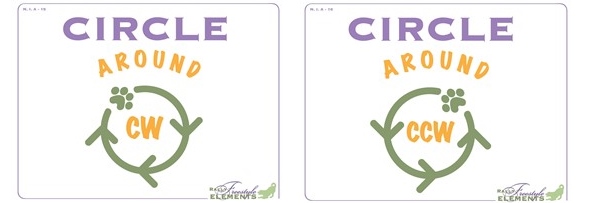
Note that the signs look very similar. The position the dog is in at the start tells you the direction they will travel. If the dog is in left heel he will travel clockwise. If he is in right heel he will travel counter-clockwise. You will never be "tricked" on a Rally-FrEe course. Your dog's position on approach to the sign indicates the direction of travel for the circle.
Below is a clip of what the foundation skill looks like when properly executed.
Some of you are probably saying “but my dog already knows that behavior.” Before skipping steps, ask yourself a few questions and ask about both the clockwise circle from your left side and the counter-clockwise circle from your right side:
1) Does my dog always start and end in a accurate position?
2) Is it as fast as I would like?
3) Is it as tight as I would like?
4) Is my dog as responsive as I would like?
5) Does my dog show confidence and fluency?
6) Does my dog respond to a verbal cue without the aid of a hand signal?
Why Use a Prop to Train Circles
By using the training gates to train the circle behavior, you now have an easy context without hand cues to train other behaviors (such as circling a cane or other prop) faster and with a greater degree of understanding in the dog.
Exercise: Set up your training gates in a single, round circle, or pen. Make sure the circle is wide enough for you in the middle (think of yourself as the hole in the donut) and your dog to move comfortably around you in a circle but not so wide that your dog can turn around. For most dogs a single gate will suffice, but for some large or giant breeds you may need to use two lengths of gates to create the appropriate size pen.
If your dog seems worried about the gates, walk him around the outside, as close as he seems comfortable, treating every couple of steps until you see him relax.
Some handlers like to use a mirror in front of them to be able to see the dog even when he is moving behind you so if this is helpful to you set that up too. Mirrors are also a great aid in helping the handler maintain a straight posture, with hips and shoulders forward. In training many of these behaviors, but especially the circle behavior, you may have the tendency to want to “help” your dog through twisting or other body english. Work hard to avoid this as it will only hinder the dog’s ability to find value in your verbal cues.
With your dog on your left or right side (you’ll be training both, so choose which side you want to start with) walk into the round pen. Be ready to click. As soon as you move into the pen, your dog is likely to move forward. That is your first click and treat (hereafter C/T). Place your reward about 2 inches in front of the dog. Don’t withhold it, but place it so your dog needs to take a small step or stretch of the neck to get it. This will help reinforce forward movement. While the dog is eating his first treat, you can close the pen.
Here is a clip of Sharon and Finn. This is their first lesson in the gates for circles. Notice the smallest movement forward earns c/t. At the time Sharon used a lot of luring in her training so you will see how difficult it is for her to keep her shoulders and head straight and not twist in an effort to prompt Finn.
Here is Phee learning circles - note how when I walk her in I am leading her in the direction I want her to travel. That action, moving along the gates is the first click. Note how I place the food forward of her just a little to help encourage and reinforce continued forward movement. You will want to be able to reward from both your right and left hands, so be sure your treats are accessible to both hands and your reaching for a treat doesn't cause your dog to shift backward.
Below is Alyssa and Jetta. Note again how Alyssa moves Jetta in heel along the gates and clicks as she turns to face forward.
Stand straight, with your hips and shoulders squared and always facing the same direction. Again, avoid turning your body, or trying to lure with your hands, arms or shoulders. Look where you want the dog to go, rather than at your dog. Giving your dog a release cue is often enough to get them moving. Keep your criteria low at first, i.e. any single step or small movement forward earns a C/T.
As your dog begins to show understanding that a step forward earns the C/T, raise your criteria to 2 steps forward before the C/T. Continue to gradually raise your criteria (your dog will often make these shifts himself) until the dog does a full revolution around you and returns to the position he started, either right or left heel position. Give several treats in a row here with lots of verbal praise to add value to getting back into this position.
In most cases, if your dog understands the C/T relationship, it will take only a couple of sessions for the dog to start to show confidence in moving in a complete circle around the handler. This of course, depends on your dog’s experience with shaping, the value of your reward, and the comfort level of your dog in the gates, as well as the usual - timing of your marker and clean handler mechanics.
Be sure to read through the "Trouble Shooting for Circle Behaviors" Lecture. This will help you solve some issues you may run into during the process.
Below is a fun clip that shows the entire process of training the foundation circle behavior. We'll start working on eliminating the gates after placing the behavior on cue.
There are several other circle signs that add handler movement to allow the dog and handler team to change direction. Here is a link to all of the Rally-FrEe signs and their descriptions. Many of the signs are linked to vid clips of the behaviors.
http://www.rallyfree.com/rally-free-signs-2016/
Gold Level students, when submitting your videos please be sure to show the whole dog and handler in your videos so that I can view not only the dog but the handler as well. Okay! let's go train! Remember to look to your dog to drive the process and most importantly have fun with this!
Instructor
Julie Flanery
Faculty
Julie Flanery (she/her), CPDT-KA has been working professionally with dogs and their handlers since 1993. She focuses on the needs of the dog and helping people form a strong relationship, through clear communication, and positive reinforcement. She has placed Obedience...
Registration
Gold
$260
Available seats: 10
- Access to all lectures and homework forums discussion
- Read all posted questions and answers
- Watch all posted videos
- Post general questions to discussion forum
- Submit written assignments
- Post dog specific questions
- Post videos (unlimited)
- Receive instructor feedback
Silver
$130
Available seats: 25
- Access to all lectures and homework forums discussion
- Read all posted questions and answers
- Watch all posted videos
- Post general questions to discussion forum
- Post dog specific questions (video only)
- Post videos (up to 2)
- Receive instructor feedback
Bronze
$65
Available seats: Unlimited
- Access to all lectures and homework forums discussion
- Read all posted questions and answers
- Watch all posted videos