AG190 The Glue for Future Agility Stars
This course is different from most foundation classes. Rather than focusing on obstacles or traditional flatwork, this class teaches the critical foundation skills (the “glue”) that will help your dog succeed as a learner in agility classes, seminars, and high-energy training environments.
Course Details
Building the Glue Skills
This course is different from most foundation classes. Rather than focusing on obstacles or traditional flatwork, this class teaches the critical foundation skills (the “glue”) that will help your dog succeed as a learner in agility classes, seminars, and high-energy training environments.
Glue skills give your dog the self-regulation, focus, and clarity needed to work and process information efficiently. Without them, your dog may become frustrated, anxious, over-aroused, fearful, or develop undesirable behaviors that interfere with learning and performance.
For All Sports or Life Skills
While this course was initially designed for dogs that will eventually compete in agility, any dog (whether destined for any sport or just basic life skills) will benefit from learning these skills. Whether your goal is competitive dog sports or simply better life skills for a family companion, glue skills create a strong framework for clear communication and efficient training.
We have had dogs being trained to eventually compete in agility, dock diving, obedience, rally, freestyle, herding, rescue/foster (to prepare for placement), and more.
Who Is This Class For?
- Open to dogs of any age
- Puppies 4 months and older are welcome (the younger puppies will progress more slowly)
- Dogs between 6 months and 2 years often benefit the most
- Suitable for a dog that is:
- Just beginning training
- Already attending classes or seminars
- Currently trialing in agility
Skills Your Dog Will Learn
- Stationing
- Focused waits
- Standby behavior
- Release cues
- Collar and leash skills
- Transport procedures
- Down stays
Skills You Will Learn
- How to plan and organize efficient training sessions
- How to keep your dog focused between repetitions
- Why lack of speed is often desirable during learning
- How to improve clarity and consistency with handling and communication
- How, when, where, and why to use reinforcement event marker cues
Video Example
Here's a video from the last day of class for Ginger and Sprite. In this session, Sprite is stationed during a training session with Ginger's older dog, Gemma. Ginger has carefully layered in more and more excitement while Sprite is stationed. And in this session, there is a lot of excitement as she sequences and rewards Gemma with tugging while reinforcing Sprite on the station. Look at how relaxed and quiet Sprite is on her station during the training.
Teaching Approach
This class takes a step-by-step approach to building various skills. Each step will have written instructions. In addition, most steps will have at least one corresponding video. Lectures are released in one batch at the beginning of the week. Feedback will mostly be written. Occasionally there will be video feedback done to help with subtle changes.
Warning!! This class is heavy on information during the first three weeks. However, the background and introductory information set you and your dog up for future success in training the skills. The last three weeks have less to cover and won't be as heavy on assignments.
This class will have a Teacher's Assistant (TA) available in the Facebook study group to help the Bronze and Silver students. Directions for joining that Facebook group will be in the classroom after you register.
Podcast
Here's a discussion Nancy had with Melissa Breau about this class on the FDSA Podcast:
Fenzi Dog Sports Podcast: E221: Nancy Gagliardi Little - "What it takes to learn agility"
Syllabus
Week 1
- Clean Cues
- Duration Behaviors
- Freeze in Position (Offered Stay)
- Release
- Event Markers (Introduction, why, when, where, location specific event markers)
- Training Session Goals
- Speed vs. Thoughtfulness
- Mistakes
- Station Introduction
Week 2
- Station - Increase Duration
- Transport - Treat magnet, Tugging
- Crating Suggestions and Discussion (dogs won't work on crating in this class but we will talk about strategies and issues that come up)
- Standby
- Leash & Collar On
- Collar Give
- Collar & Leash Pressure
- Small dogs - Consent to be picked up
Week 3
- Station - Reduce Reinforcement, Add Distractions
- Down Position
- Offered Down Stay
- Down Stay - Eye Contact, Vary Handler Position, Slight Duration
- Standby - Freeze, Duration
- Transport - Leash, Carry Dog
- Transport - Treat Magnet - Increase Distance
Week 4
- Down Stay - Duration and Simple Distractions
- Work Away From Reinforcement
- Station - Eliminate/Reduce Reinforcement, Increased Distractions
- Transport - Station to Recall
- Standby - Add Work
Week 5
- Station – Add Work
- Down Stay - Lengthen Duration, Increase Distractions
- Waiting Strategies
Week 6
- Down Stay - Eliminate Reinforcement, Add Work
- Station - Advanced Training
Prerequisites & Supplies
Sample Lecture
Speed in Agility
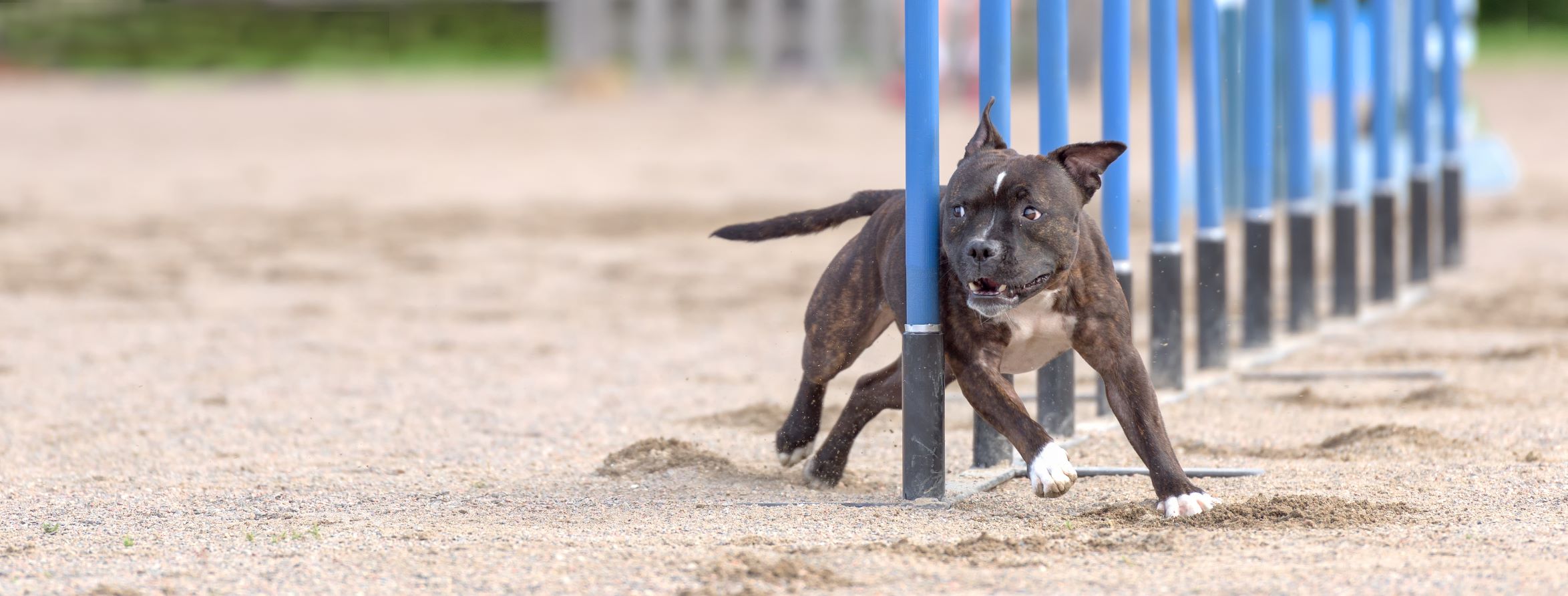
Agility trainers struggle with the belief that they should allow their dogs to be slower and more thoughtful when training agility obstacles and concepts. Many agility dogs are expected to learn complex behaviors while being asked to pick up energy and speed, often in a stimulating environment.
Ask any successful athlete, and they will agree that it is more important to learn to execute the skill or routine first - slowly and accurately - before adding more energy, intensity, or speed.
When your dog is learning something new, it will take time to become proficient at the skill. However, this slow and accurate learning process has its benefits. Allowing the dog to perform the skill slowly with helpful reinforcement procedures will build confidence in the dog. This confidence, in turn, builds enthusiasm and speed. A dog that is frantic and hectic while performing is not focused on the execution. Building speed into an exercise before the dog understands how to use the body properly will cause many incorrect responses during the learning process. When that happens, it becomes difficult for the dog to figure out – especially when the human wants speed on top of it all.
After becoming more confident with their jumping skills or other obstacle performances, some of my fastest dogs picked up even more speed. It's crucial to understand that rushing for speed before knowledge or precision can lead to many mistakes. And depending on how you or your dog responds to those mistakes, anything can happen. You might have a dog that learns to ignore handling (creating off-courses at high speed) or a dog with frantic behaviors that cause more errors. You can even create the opposite of what you want - a dog that learns to move slowly. So, it's essential to be mindful of the learning pace.
Imagine if you were learning a new app or software package, and the instructor pushed you to execute faster than you could process. It would be frustrating, confusing, and stressful. Now, let's think about our dogs. They're learning a new skill; just like us, they need time to process and understand. Let's be patient and allow them to ask questions, just like we would in a learning situation.
Instructor

Nancy Gagliardi Little
Faculty
Nancy Gagliardi Little (she/her) has been training dogs since the early 1980s, when she put an OTCH on her Novice A dog, a Labrador retriever. Since then she has put many advanced obedience titles on her dogs, including 4 AKC OTCH titles, 6 UD titles, 3 UDX titles, and multiple...
Registration
Gold
$260
Enrollment limit: 12
- Access to all lectures and homework forums discussion
- Read all posted questions and answers
- Watch all posted videos
- Post general questions to discussion forum
- Submit written assignments
- Post dog specific questions
- Post videos (unlimited)
- Receive instructor feedback
Silver
$130
Enrollment limit: 25
- Access to all lectures and homework forums discussion
- Read all posted questions and answers
- Watch all posted videos
- Post general questions to discussion forum
- Post dog specific questions (video only)
- Post videos (up to 2)
- Receive instructor feedback
Bronze
$65
Enrollment limit: Unlimited
- Access to all lectures and homework forums discussion
- Read all posted questions and answers
- Watch all posted videos
Why choose us?
We offer a variety of online training solutions designed to help you and your furry friend achieve success
Our testimonials
Don't just take our word for it — see what our clients say about their experience working with us.
As a newbie to dog sports I find the Fenzi academy an incredible way to get the best instruction from a wealth of knowledgable instructors with no intimidation or sense that I can't participate in a class alongside excellent seasoned trainers.
Read all testimonialsThis class model has been so helpful, regardless of level of participation. I feel I learned so much from the lecture materials and the participants' videos/feedback. Feedback was specific and easy to follow. I can see so much change already in my and my dog's performance, and in our relationship. I can't wait for the next class!
Read all testimonialsI am continually amazed at how much I learn with each class. Watching both the teacher's video's and the student's videos gives me lots of opportunity to think through the elements and break it down for myself and my dog.
Read all testimonials